
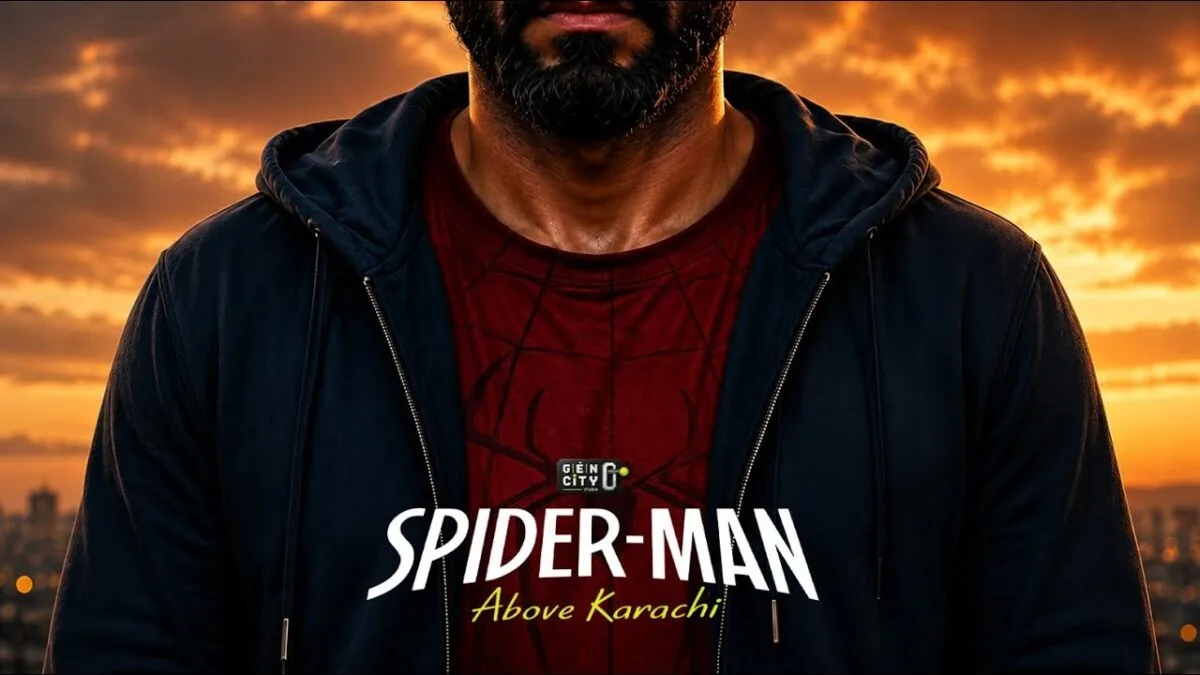


Imagine Spider-Man swinging through New York. The skyscrapers are familiar, the streets are busy, and the city below is his world. Now replace Manhattan with Karachi and ask a different question: what if Spider-Man lived in Karachi and protected the city he called home?
That question inspired Spider-Man – Above Karachi, an AI-generated short film by Sibghat Shaikh, exploring AI filmmaking in Pakistan. Using generative AI and cinematic storytelling, Shaikh reimagined Spider-Man through Karachi’s streets, urban life, and everyday challenges—turning a global superhero concept into a story rooted in a local city.
The result is not simply Spider-Man placed against a Karachi background. It is an attempt to imagine what a superhero story could look like when Karachi itself becomes part of the character’s world.
Karachi Is Used to Its Problems. But What If It Had a Hero?
Karachi is a city of contradictions.
It is crowded and energetic. It can be chaotic and beautiful at the same time. Its streets are full of movement, its neighborhoods have distinct identities, and millions of people navigate the city every day while adapting to its challenges.
Those challenges are part of the city’s reality.
Crime, phone snatching, fires, flooding, traffic, and other everyday problems can make life difficult. But Karachi is not simply a city defined by those problems. It is also a city known for its resilience, creativity, diversity, and energy.
That complexity makes it an interesting setting for a superhero story.
Superhero cinema has traditionally given its heroes cities that become almost as recognizable as the characters themselves. New York is closely associated with Spider-Man. Gotham is associated with Batman.
So why shouldn’t Karachi have its own superhero world?
That was the creative question behind Spider-Man – Above Karachi.
Instead of inventing another fictional city, the project brings a familiar superhero concept into a place that millions of people already know.

Then Came a Different Kind of Spider-Man
This is where Sibghat Shaikh, a Pakistani AI filmmaker, film director and producer, enters the story.
Shaikh imagined a different version of Peter Parker—one who lives in Karachi and identifies himself as a filmmaker.
After a spider bite changes his life, Peter becomes Spider-Man.
But this Spider-Man has a very different city to protect.
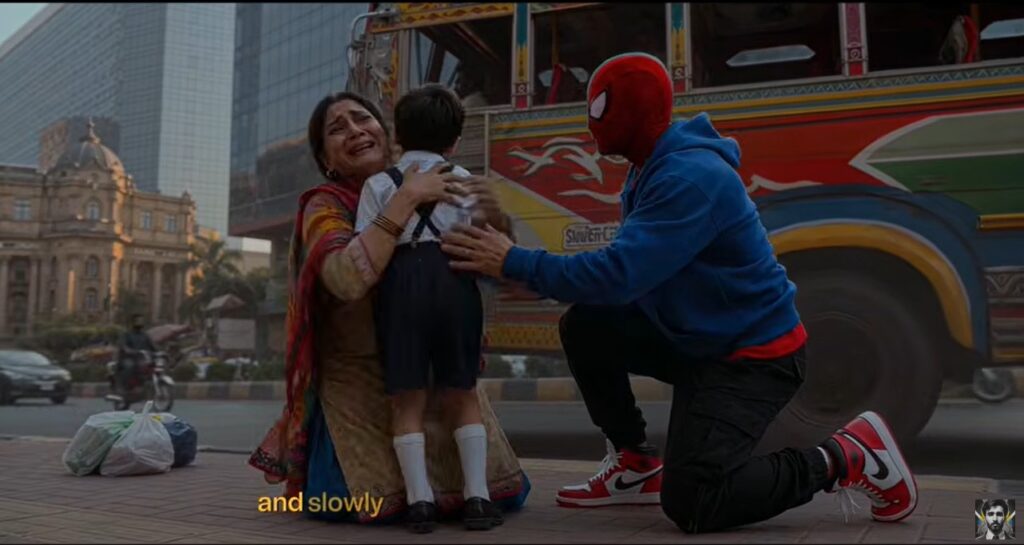
The film places him within situations involving phone snatching, robberies, fires, and flooding. These are not abstract superhero problems. They are connected to the kinds of challenges people can recognize in Karachi.
That changes the character.
In a traditional Spider-Man story, the city is often the setting for battles between a superhero and extraordinary villains.
In this version, the idea becomes more local.
What would a superhero actually do if he lived in Karachi?
Who would he help?
What would he see from above?
And what would make him feel responsible for the people below?
Those questions give Spider-Man – Above Karachi its personality.
What Would Spider-Man Actually Do in Karachi?
The answer begins with the city itself.
A Karachi Spider-Man would not simply be solving problems that could happen anywhere. His world would be shaped by the environment around him.
A phone snatching incident can become a moment for a superhero to intervene. A robbery can become another reason for him to act. A burning building can turn the superhero’s abilities into a tool for helping people. Flooding can transform familiar streets into an entirely different landscape.
These situations give the film a distinctly Karachi context.
The interesting contrast is that Spider-Man remains a globally recognizable character, while the problems around him are local.
That combination creates something audiences can immediately understand.
It is Spider-Man.
But it is also Karachi.
This Wasn’t Just About Making Spider-Man. It Was About Making Karachi Feel Seen.
That may be the most important part of the project.
Creating an AI version of Spider-Man is technically interesting.
Creating a Spider-Man who feels connected to Karachi is a storytelling challenge.
The city’s streets, architecture, atmosphere, and everyday realities needed to become part of the visual world.
The concept was essentially:
global superhero + local city + local problems + local visual identity.
For someone who knows Karachi, that changes the experience of watching the film.
It is one thing to see an AI-generated superhero.
It is another to see that superhero moving through an environment that feels familiar.
The reaction becomes less about the technology and more about recognition.
That’s Karachi.
That is what makes the project more than an experiment with generative AI.
It gives a familiar global character a local home.
From a Fan Idea to a Film
Spider-Man – Above Karachi began as a personal fan project and developed into an experiment in AI filmmaking.
For Shaikh, the idea was not simply to demonstrate what an AI video tool could do.
The technology offered a way to visualize a concept that would have been considerably more demanding through a conventional production process.
A superhero film normally involves locations, actors, costumes, crews, visual effects, action planning, and many other production requirements.
Generative AI provided another route to explore the idea.
That did not make the filmmaking process automatic.
It simply changed the production equation.
The creative question came first:
What would happen if Spider-Man belonged to Karachi?
AI became one of the ways to answer it.
The Hard Part Was Making the Dream Look Like One Film
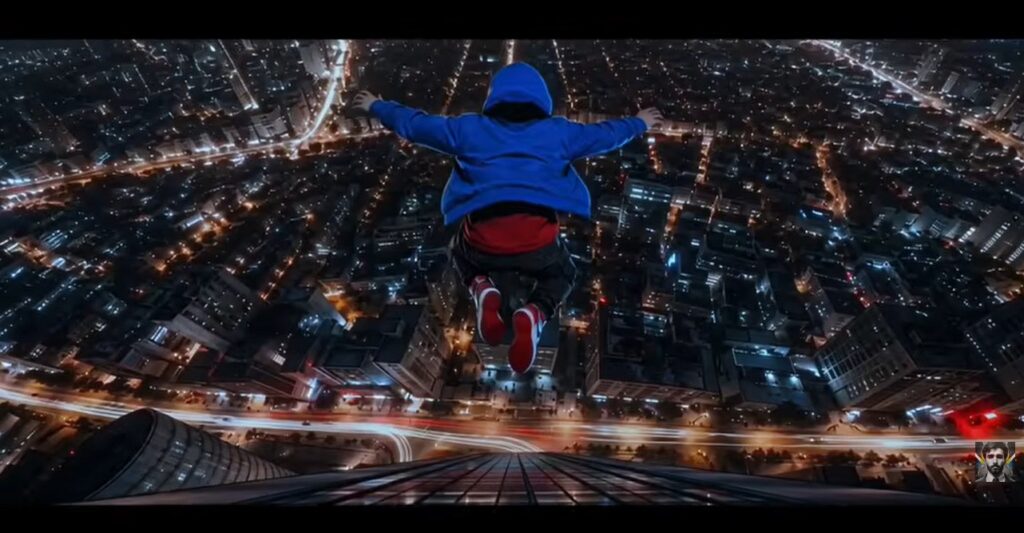
Generating one impressive AI shot is not the same as making an AI film.
That became one of the biggest challenges of the project.
Spider-Man – Above Karachi involved approximately 40 shots, and those shots needed to feel as though they belonged to the same story.
The character had to remain recognizable.
The world had to remain coherent.
The visual language needed to feel consistent.
That meant paying attention to the character’s face, appearance, costume, environment, buildings, lighting, proportions, and continuity.
A single strange generation might be easy to ignore.
But if Spider-Man suddenly looks like a different person after a cut, or the environment changes in a way that makes no narrative sense, the illusion starts to disappear.
This is the difference between AI video generation and AI filmmaking.
The first can produce a shot.
The second requires a filmmaker to make the shots work together.
AI Was the Tool. The Story Was Still Human.
The technology behind the project included Seedance 2 through Dreamina AI for visual generation, Topaz Labs for upscaling selected footage, CapCut for editing, and Seed Audio 1.0 for voiceover.
But the tools are not really the story.
They are the production tools that helped bring the idea to the screen.
Approximately 150 generations went into the process, which says something important about how AI filmmaking actually works.
It is not necessarily:
Prompt → movie.
It is much closer to:
Generate → review → reject → regenerate → refine → select.
Someone still needs to decide which shot works.
Someone needs to decide when a sequence is too slow.
Someone needs to notice when continuity is broken.
Someone needs to decide what the audience should see and what should be removed.
That is filmmaking.
AI can reduce some production barriers, but it does not replace story, pacing, timing, editing, visual direction, or creative taste.
Why People Connected With Spider-Man – Above Karachi
The project also attracted attention because the idea itself was easy to understand.
People didn’t need to know how generative AI worked to understand the concept.
They could simply ask:
What if Spider-Man lived in Karachi?
According to coverage from The Current, the film generated social-media attention and enthusiastic reactions around its concept, script, title, characters, editing, creativity, and especially its Karachi setting.
Some viewers even responded to the central premise by suggesting that Karachi needed a Spider-Man of its own.
That reaction is important because it shows that the emotional hook existed before the technology entered the conversation.
People connected with the idea of seeing their city represented through a superhero story.
The AI was interesting.
Karachi was personal.
Maybe Karachi Didn’t Need a Superhero. Maybe It Needed to See Itself as One.
There is something bigger behind a project like this.
For years, many of the world’s biggest cinematic stories have been built around cities that audiences everywhere recognize.
But local filmmakers can also take those kinds of visual ideas and reinterpret them through their own experiences.
That is where AI filmmaking in Pakistan becomes particularly interesting.
Generative AI can give independent filmmakers new ways to experiment with Pakistani cities, characters, environments, and stories without every idea requiring the resources of a large traditional production.
It does not mean AI will replace conventional filmmaking.
It means there is another tool available.
For a Pakistani AI filmmaker, that tool can help turn an idea that once existed only in the imagination into something audiences can actually see.
And perhaps the most exciting possibility is not making another version of a Hollywood story.
It is asking what happens when Pakistani filmmakers start creating worlds that feel unmistakably their own.
The View From Above
We have seen Spider-Man swing through New York for decades. But seeing Spider-Man above Karachi changes the question.
It is no longer simply:
“Can AI make Spider-Man?”
The more interesting question is:
“What stories become possible when filmmakers can put their own cities at the center of the frame?”
That is what makes Spider-Man – Above Karachi more than an AI-generated short film.
It is a creative experiment in taking a globally recognizable superhero, placing him in a distinctly Pakistani environment, and imagining Karachi as a cinematic world of its own.
For Sibghat Shaikh, the project began with a fan idea. AI helped bring the idea to life. But the story belongs to Karachi.
And maybe that is the real superhero moment—not seeing Spider-Man above another city, but seeing Karachi finally get its own hero.