
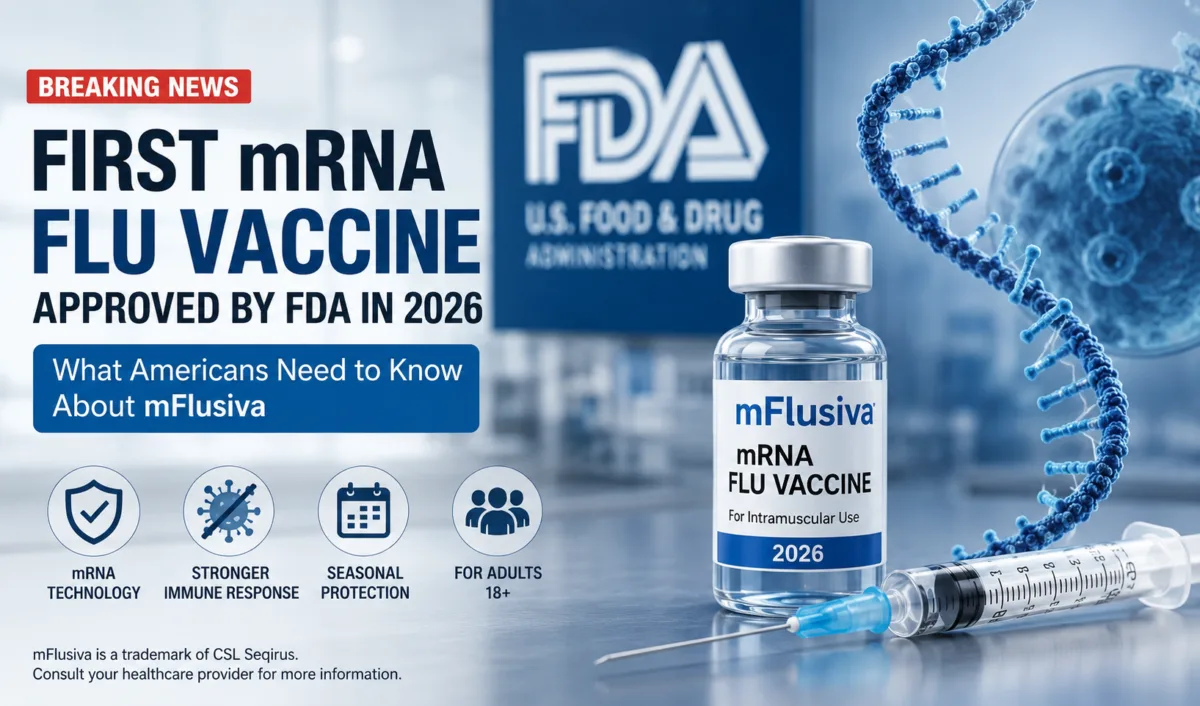


A historic moment in vaccine history happened this week, and most Americans have not fully absorbed what it means yet. The mRNA flu vaccine FDA approved 2026 marks the first time messenger RNA technology, the same technology behind the COVID-19 vaccines that changed the course of a pandemic, has been licensed for influenza protection in the United States. On August 5, 2026, the Food and Drug Administration approved Moderna’s mFlusiva for adults age 50 and older, making it available for the upcoming fall flu season. In clinical trials involving more than 40,000 people, the new shot proved about 27 percent more effective than traditional flu vaccines. Here is everything you need to know about what this approval means, who it is for, and what to expect when flu season begins this fall.
What Exactly Was Approved and Who Can Get It
The FDA approved Moderna’s mFlusiva on August 5, 2026, for adults aged 50 and older. As NBC News reported on the approval announcement, the FDA actually granted approval for two separate age groups: adults 50 to 65, and adults 65 and older. However, the approval for the 65-and-older group came with an important condition: it was issued as an accelerated approval, meaning Moderna is required to conduct an additional clinical trial specifically in that older age group and submit the results to the FDA. This two-track approach reflects the agency’s desire to get the vaccine available for flu season while ensuring additional safety and efficacy data for the population at highest risk from influenza complications.
Moderna CEO Stephane Bancel said in a statement that flu remains a significant public health challenge and mFlusiva provides an important new option for America’s seniors. The company says it expects the vaccine to be available to patients this fall as the annual flu vaccine campaign begins across the country.
How Much More Effective Is It Really
The clinical trial data behind mFlusiva is the most compelling part of this story. As TIME Magazine’s detailed analysis of the approval explained, in a study published in May 2026 in the New England Journal of Medicine, the mRNA flu shot was up to 27 percent more effective than any of four currently available flu shots in preventing lab-confirmed influenza-like illness.
The trial enrolled more than 40,000 adults age 50 and older who were randomly assigned to receive either a single dose of mFlusiva or one of four existing flu shots. Those who received the mRNA vaccine were on average 27 percent less likely to develop confirmed influenza symptoms. In a disease that kills between 12,000 and 52,000 Americans every year depending on how severe the season is, a 27 percent improvement in protection is a meaningful number, not a marginal gain.
To put that in context, traditional flu vaccines have historically ranged from about 40 to 60 percent effective in seasons where the vaccine strains match the circulating viruses well, and as low as 10 to 20 percent effective in seasons where the match is poor. The 27 percent improvement that mFlusiva showed was measured against already-available flu shots, meaning the new vaccine offers meaningful additional protection on top of what currently exists.
Why mRNA Changes the Game for Flu Vaccines
To understand why this approval matters beyond just this single flu season, it helps to understand what has always been frustrating about traditional flu vaccines and how mRNA technology changes that equation.
The Timing Problem With Traditional Flu Shots
Every year, scientists have to select which influenza strains to include in the seasonal flu vaccine during the preceding February, nearly nine months before the vaccine is actually used. As CNN’s coverage of the approval explained, Moderna’s mRNA flu vaccine requires less time between strain selection and public circulation. This means scientists can wait longer to see which strains are actually circulating before locking in the vaccine formula, allowing for a closer match between the vaccine and the actual viruses making people sick that fall.
This is one of the most consistent frustrations with flu vaccines from a public health perspective. In years when the selected strains do not match what ends up circulating widely, effectiveness drops sharply. A faster manufacturing process enabled by mRNA technology could significantly reduce how often that mismatch occurs, which would translate directly into better protection for millions of Americans year after year.
Faster to Make, Easier to Update
Traditional flu vaccines are manufactured using chicken eggs, a process that takes months and has limited flexibility for last-minute changes. mRNA vaccines are synthesized in laboratories using genetic instructions, a process that is faster, more scalable, and easier to update when a new strain needs to be included. This manufacturing advantage was demonstrated clearly during COVID-19, when mRNA vaccines were developed, tested, and manufactured at a speed that was genuinely unprecedented in vaccine history.
Applying that same manufacturing platform to influenza opens the door to more responsive, more accurate flu vaccines over the long term. It also creates a foundation for future combination vaccines. The European Medicines Agency has already recommended approval of Moderna’s combined mRNA COVID-19 and flu vaccine, called mCombriax, which would allow people to get protection against both viruses in a single shot.
The Political Drama Behind the Approval
The approval of mFlusiva this week came after an unusually turbulent regulatory process that reflects the complicated political environment surrounding vaccines in the United States right now. As STAT News documented in its detailed account of the approval process, in February 2026, Vinay Prasad, the FDA’s head of biologics at the time, overturned the recommendation of career FDA staff and issued a rare refusal-to-file notice to Moderna, saying the agency would not review the vaccine based on the available data package.
Two weeks later, after Moderna publicly disclosed the FDA’s decision and expressed its displeasure, Prasad’s decision was reversed. As NPR’s coverage of the political context explained, the FDA’s initial refusal was widely understood to have been influenced by the Trump administration’s hostility toward mRNA technology and the broader backlash against COVID vaccine policies, as well as by criticism from HHS Secretary Robert F. Kennedy Jr., who has been a long-time vaccine critic.
When the approval ultimately came through, Kennedy’s HHS offered a carefully worded statement. A spokesperson said Secretary Kennedy believes mRNA products warrant heightened scientific scrutiny, which is why this vaccine is entering the market with some of the strongest post-market study commitments the FDA has required, particularly for individuals 65 and older. As NBC News noted, many scientists and public health experts had touted the idea of an mRNA flu vaccine for years, and the approval was being closely monitored because of the political environment surrounding vaccine policy.
Who Should Get mFlusiva This Fall
Based on the FDA’s approval, mFlusiva is available for adults age 50 and older. That age threshold reflects both where the clinical trial data is strongest and the current state of US federal guidance on flu vaccination.
The Trump administration revised flu vaccination guidelines earlier this year, shifting away from the previous recommendation that anyone six years and older should receive an annual flu shot, toward a more targeted recommendation focused on those at highest risk from flu complications. As TIME Magazine explained, while the CDC continues to maintain the broader recommendation on its website, in January the Trump administration revised this guidance and shifted the decision to vaccinate to individual families and their physicians. Many health organisations including the American Academy of Pediatrics and the American Medical Association disagree with the narrowed guidance.
For adults 50 and older, particularly those with underlying health conditions that increase flu risk, mFlusiva represents a genuinely new and potentially superior option this flu season. For people in the 65-and-older group who have previously received the high-dose flu vaccine recommended for seniors, talking with a doctor about whether to switch to mFlusiva or stay with a high-dose traditional vaccine is a reasonable step before flu season begins.
Side Effects: What to Expect
The side effects of mFlusiva are consistent with what people experienced from mRNA COVID vaccines and from flu shots generally. According to CNN’s summary of the clinical data, reported side effects include injection site reactions such as pain, tenderness, and swollen lymph nodes; fatigue; headache; muscle or joint pain; nausea or vomiting; and fever.
These are temporary, expected immune responses and do not indicate that anything has gone wrong with the vaccine. They typically resolve within one to three days and are generally milder in older adults than in younger people. The presence of these side effects is actually a signal that the immune system is responding to the vaccine and building protection, though their absence does not mean the vaccine is not working.
For anyone with a history of severe allergic reactions to vaccines or vaccine components, discussing mFlusiva with a doctor before getting the shot is important, as it is with any new vaccine.
What This Means for the Future of Vaccine Technology
Beyond the immediate impact on this flu season, the approval of the first mRNA flu vaccine carries enormous implications for how vaccines are developed and deployed going forward.
Moderna’s mRNA platform is already being studied for vaccines against respiratory syncytial virus, HIV, cancer, and several other diseases. As the COVID-19 experience demonstrated, mRNA technology can be adapted rapidly when a new pathogen or variant emerges. The approval of mFlusiva strengthens the regulatory pathway for future mRNA vaccines by establishing that the technology can work safely and effectively for a common, annually circulating respiratory virus, not just a pandemic emergency. As Moderna CEO Bancel said in his approval statement, this approval also reflects the ongoing potential of the mRNA platform to help address important public health challenges through continued scientific innovation.
For the US specifically, this approval arrives at a moment when the relationship between mRNA technology and federal health policy has been genuinely complicated by political headwinds. The fact that the vaccine made it through despite those headwinds, and did so with the support of the clinical trial data behind it, is significant for the trajectory of vaccine science in this country. For a broader picture of how medical research is evolving in 2026, our piece on Ozempic and emerging cancer prevention research shows how quickly new findings are reshaping what doctors and patients know about medications and health outcomes.
Frequently Asked Questions (FAQs)
Q1. What is mFlusiva and who makes it?
mFlusiva is Moderna’s mRNA-based influenza vaccine, the first flu shot in the United States to use messenger RNA technology. It was developed using the same mRNA platform that Moderna used for its COVID-19 vaccines. The FDA approved it on August 5, 2026, for adults age 50 and older.
Q2. How much more effective is the mRNA flu vaccine compared to regular flu shots?
In clinical trials involving more than 40,000 adults age 50 and older, mFlusiva was found to be about 27 percent more effective than standard flu shots in preventing lab-confirmed influenza-like illness. The trial compared the mRNA vaccine against four different existing flu vaccines, and mFlusiva outperformed all of them on average.
Q3. Can everyone get the mRNA flu vaccine this fall?
The FDA approved mFlusiva for adults age 50 and older only. It is not currently approved for people under 50. Adults 65 and older received accelerated approval, meaning Moderna must conduct additional trials in that group and submit results to the FDA. People under 50 who want flu protection should continue using currently available flu vaccines as recommended by their doctor.
Q4. What are the side effects of the mRNA flu vaccine?
Reported side effects from clinical trials include injection site pain, tenderness, and swollen lymph nodes, as well as fatigue, headache, muscle or joint pain, nausea or vomiting, and fever. These are typical immune responses that usually resolve within one to three days and are consistent with what people experience from other flu shots and mRNA vaccines.
Q5. Why did the FDA initially refuse to review mFlusiva in February 2026?
In February 2026, the FDA’s head of biologics issued a rare refusal-to-file notice saying the agency would not review the vaccine based on the available data package. This decision was reversed two weeks later after Moderna publicly disclosed it and expressed concern. The initial refusal was widely understood to have been influenced by the Trump administration’s political hostility toward mRNA technology and HHS Secretary Robert F. Kennedy Jr.’s vaccine skepticism.
Q6. When will mFlusiva be available and where can I get it?
Moderna has said it expects mFlusiva to be available this fall as flu vaccine campaigns begin across the United States. It will be available through pharmacies, doctor’s offices, and other vaccination sites that typically distribute flu shots each season. Check with your doctor or pharmacy closer to flu season for specific availability in your area.
The approval of the mRNA flu vaccine FDA approved 2026 is the kind of medical milestone that deserves more attention than it has received in the news cycle. After years of researchers promising that mRNA technology could revolutionise vaccine development beyond COVID, the approval of mFlusiva is the first concrete proof that those promises are being kept. A flu vaccine that is 27 percent more effective than existing options, faster to manufacture, and easier to update, available to tens of millions of American adults this fall, is genuinely meaningful news for public health. Talk to your doctor before flu season begins about whether mFlusiva is the right choice for you. For more health and medical news shaping American life in 2026, keep reading Weblogs4u.