
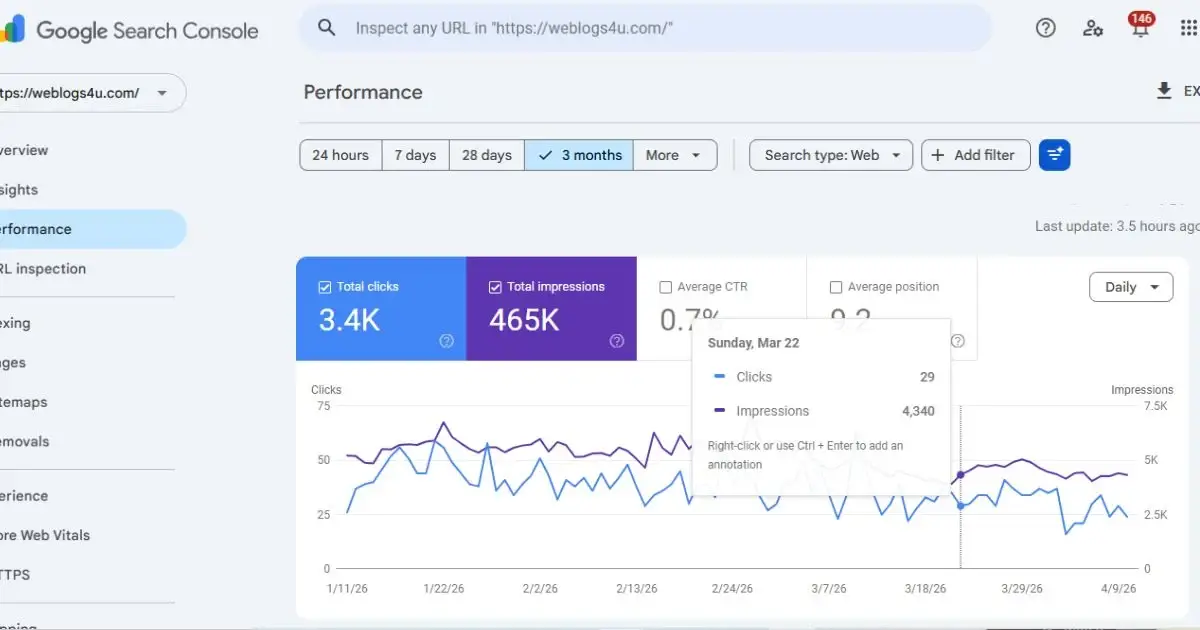


If you are a blogger who has been staring at Google Search Console watching your articles sit in the “Discovered — currently not indexed” graveyard, this case study is for you. This is the real story of how Weblogs4u.com went from zero indexing for six months straight to getting articles indexed again in February 2026. No paid tools. No shortcuts. Just consistent work and the right strategy.
Who Is Weblogs4u.com?
Weblogs4u.com is a multi-niche blog covering topics like Real Estate, Finance, Health and Fitness, Technology, Travel, and Lifestyle. The site launched in 2024 and started gaining traction with regular content publishing across multiple categories. Articles were going up, content quality was decent, and things looked promising.
Then August 2025 happened.
The Problem — Six Months With Zero Indexing
Starting from August 2025, newly published articles on Weblogs4u.com simply stopped appearing in Google Search. It was not a gradual decline. It was a wall.
Google Search Console was showing the same painful messages every single day:
- Discovered — currently not indexed
- Crawled — currently not indexed
- URL is not on Google
Manually requesting indexing through the URL Inspection tool did nothing. Submitting the sitemap did nothing. Traffic flatlined. New content was being published into a black hole. For any blogger, this is one of the most demoralizing situations you can face — you are putting in the work but Google is completely ignoring you.
This went on for six months.
What Was Happening on Google’s Side?
This was not a random or isolated problem. Between mid-2025 and early 2026, Google rolled out a series of major algorithm updates that hit thousands of small and growing blogs hard.
The December 2025 core update ran from December 12 to December 29, followed by the February 2026 Discover update and a March 2026 spam update that completed in under 20 hours — the fastest spam update in Google history. Search Engine Land
The March 2026 core update amplified E-E-A-T signals — Experience, Expertise, Authoritativeness, and Trustworthiness — more aggressively than any previous core update. Sites that demonstrated real expertise and author credibility saw ranking gains, while mass-produced content without genuine depth was penalized. Digital Applied
The key takeaway from Google’s direction in 2026 was clear: less focus on tricks, more focus on useful content, better site structure, and genuine authority in the niche. Webmaster World
Google was going through one of the biggest quality filtering phases in its history. Weblogs4u.com, like thousands of other growing blogs, got caught in that filter. The site was not doing anything wrong — it just had not yet demonstrated enough authority, freshness, and technical signals to earn Google’s trust consistently.
What We Did — The Exact Steps That Fixed It
There was no single magic fix. What worked was a combination of consistent technical improvements and content upgrades applied over several months. Here is exactly what was done:
Step 1 — Manually Submitted Every URL in Search Console
Every single new article published was immediately submitted through the URL Inspection tool in Google Search Console. Instead of waiting for Google to discover the pages on its own, we pushed every URL directly. This did not cause instant indexing but it kept Google’s attention on the site and signaled that new content was being added regularly.
Step 2 — Refreshed and Resubmitted the Sitemap
The old sitemap was deleted and a fresh one was generated using Rank Math Pro. The new sitemap was submitted directly in Google Search Console under the Sitemaps section. Rank Math was configured to automatically update the sitemap every time a new article was published, ensuring Google always had an up-to-date map of the site.
Step 3 — Updated Old Articles With Fresh Content
Rather than only publishing new articles, we went back to older posts and updated them. Outdated statistics were replaced with 2025 and 2026 data. New sections were added to existing articles. Word counts were improved. Publish dates were updated to reflect the changes.
This was one of the most important steps. Google’s Discover update in February 2026 made it clear that being fast is not enough and being first is not enough — durable visibility increasingly depends on whether a page actually adds something distinctive and worthwhile. ALM Corp Updating old content showed Google that the site was actively maintained and that existing articles were being improved rather than abandoned.
Step 4 — Built Strong Internal Links
Every new article published included at least two or three internal links pointing to related older articles on the site. This created a web of connections across the blog that made it easier for Google’s crawlers to move through the site and discover pages they may have missed. Internal linking also increased the time readers spent on the site, which is a positive engagement signal.
Step 5 — Added Schema Markup Across the Entire Site
Using Rank Math Pro, Article schema was set globally under Titles and Meta settings. This meant every blog post automatically received structured data markup without having to set it manually for each article. Schema helps Google understand what a page is about, who wrote it, and when it was published — all signals that contribute to indexing confidence.
For high-priority articles, FAQ schema was added manually to target rich results in Google Search, which increases click-through rates and makes content more visible in search results.
Step 6 — Improved Author Information
A practical observation from SEO data during the 2026 updates was that author bylines with linked bio pages correlated strongly with ranking stability. Sites using generic attributions like Staff Writer were more likely to have been negatively affected than sites where specific authors were identified with detailed expertise pages. Digital Applied
Author profiles on Weblogs4u.com were updated with real names, proper bio descriptions, and profile information. This small but important change improved the site’s E-E-A-T signals in Google’s eyes.
Step 7 — Never Stopped Publishing
Perhaps the most underrated step of all. Even during the six months when nothing was getting indexed, publishing continued. Articles kept going up across all categories. This consistency signaled to Google that the site was alive, active, and committed — not an abandoned or low-effort blog.
Many bloggers make the mistake of stopping completely when indexing problems hit. That is exactly the wrong move. Google rewards consistency. A site that keeps publishing quality content even during a rough patch is far more likely to recover than one that goes silent.
The Result — February 2026
After six months of applying these steps consistently, articles on Weblogs4u.com began indexing again in February 2026. The recovery coincided with Google’s February 2026 Discover update, which rewarded sites that publish clear, topic-focused, well-structured, and fact-driven content. ALM Corp
That is exactly what Weblogs4u.com had been building toward for six months. And Google finally noticed.
New articles started appearing in search results within days of publishing. Search Console began showing green signals instead of the dreaded “not indexed” messages. Traffic started moving again.
What This Taught Us About Google in 2026
This experience revealed several important truths about how Google works in 2026 that every blogger should understand.
Google is not your enemy. When your site stops indexing, it does not mean Google hates you. It means Google has not yet built enough trust in your site to prioritize crawling and indexing your content. Your job is to earn that trust through consistent quality and proper technical setup.
Technical SEO matters more than ever. Schema, sitemaps, internal linking, and Search Console activity are not optional extras. They are the foundation that tells Google your site is serious, organized, and trustworthy.
Content freshness is a real signal. Updating old articles is just as important as publishing new ones. Google wants to show users the most current and accurate information available. A site that regularly refreshes its content is more likely to be trusted with consistent indexing.
Author identity builds trust. In 2026, Google cares about who is writing content. Real author names, bio pages, and expertise signals help Google classify your content as trustworthy rather than anonymous filler.
Consistency is the most powerful long-term strategy. Six months is a long time to keep working without visible results. But that consistency is exactly what eventually triggered recovery. There is no shortcut to building genuine authority in Google’s eyes.
A Message to Every Blogger Struggling Right Now
If your blog is not indexing, if your articles are invisible in Google Search, if you have been grinding for months with nothing to show for it — do not quit.
What happened to Weblogs4u.com is happening to thousands of blogs right now. Google’s algorithm changes between 2025 and 2026 created a difficult environment for growing sites. But the bloggers who kept working, kept improving their content, kept fixing their technical issues — they are the ones coming out the other side.
Weblogs4u is proof that recovery is possible. Six months of no indexing. Then February 2026 came and everything changed.
Your site can do the same. Fix your technical setup. Update your content. Add schema. Build internal links. Keep publishing. And most importantly — do not stop.
The bloggers who survive Google’s hardest updates are not the most talented. They are the most consistent.
Keep going.
Quick Action Checklist for Bloggers With Indexing Problems
| Action | Priority |
|---|---|
| Submit every URL manually in Search Console | 🔴 Do it today |
| Refresh and resubmit your sitemap | 🔴 Do it today |
| Update at least 5 old articles with fresh content | 🟠 This week |
| Add internal links to every new article | 🟠 This week |
| Set up Article schema via Rank Math or Yoast | 🟠 This week |
| Update author bios with real names and details | 🟡 This month |
| Publish consistently — minimum 2 articles per week | 🟡 Ongoing |