
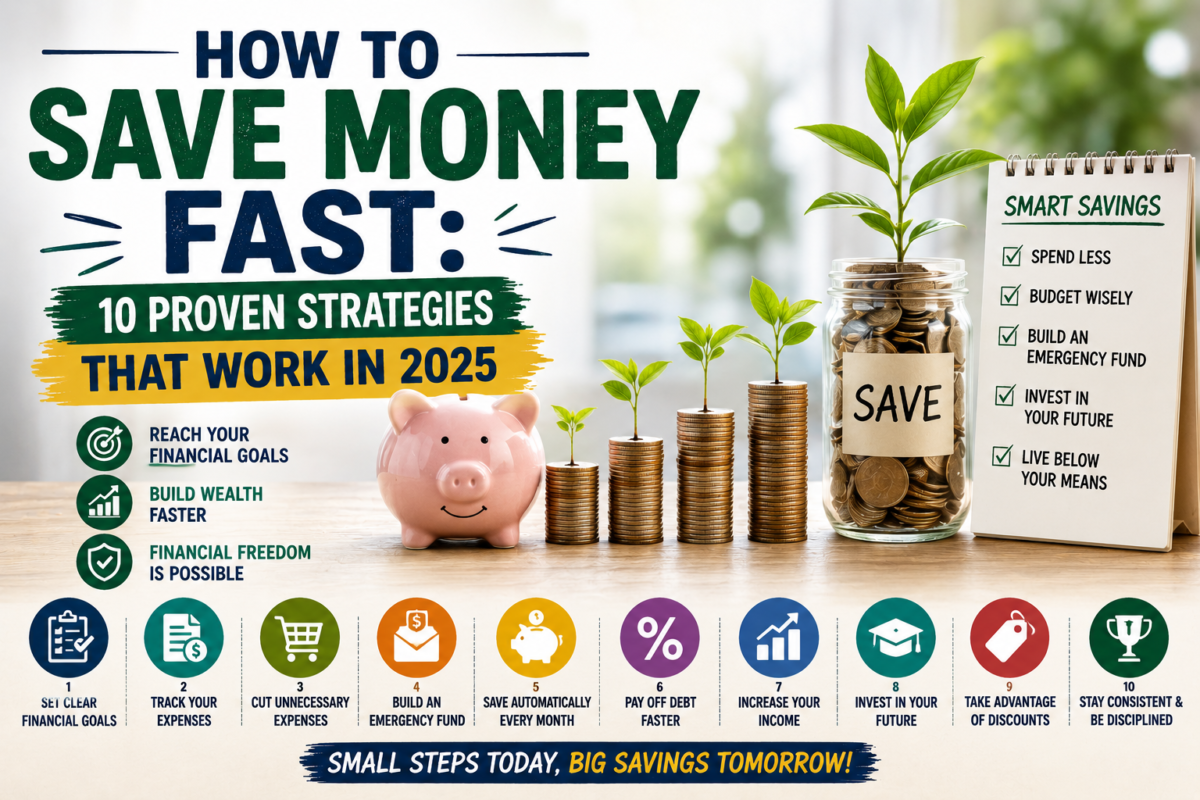


Whether you are trying to build an emergency fund, pay off debt, save for a vacation, or simply stop living paycheck to paycheck — knowing how to save money fast is one of the most valuable financial skills you can develop. The good news: you do not need a high salary to save serious money. You need a system.
Here are practical, no-nonsense strategies that will help you save more money starting this month.
1. Track Every Expense for 30 Days
Before you can cut spending, you need to see exactly where your money goes. Most people are shocked when they actually track their expenses for a full month. That daily coffee, the streaming subscriptions you forgot about, the impulse Amazon purchases — they add up to hundreds of dollars monthly.
Use a free app like Mint, YNAB, or simply a spreadsheet. Seeing your spending in black and white is usually enough motivation to start cutting immediately.
2. Apply the 50/30/20 Budget Rule
The 50/30/20 rule is the simplest budgeting framework that works for most households:
- 50% of your income goes to needs — rent, groceries, utilities, transport
- 30% goes to wants — dining out, entertainment, shopping
- 20% goes to savings and debt repayment
If saving 20% feels impossible right now, start with 5% and increase it by 1% each month. Automate the transfer so you never see the money in your spending account.
3. Cancel Subscriptions You Don’t Actually Use
The average person pays for 4–6 subscription services they barely use. Go through your bank statements right now and identify every recurring charge. Cancel anything you have not used in the past month. Gym memberships, streaming services, app subscriptions, magazine subscriptions — eliminate ruthlessly.
This single action typically frees up $50–$200 per month for the average household.
4. Cook at Home More Often
Eating out is one of the biggest budget killers. The average restaurant meal costs 5 times more than the same meal prepared at home. If you currently eat out or order delivery five times per week and reduce it to twice, you could save $300–$500 monthly without feeling deprived.
Meal prepping on Sundays is the most effective strategy. Cook in bulk, portion meals for the week, and remove the temptation of ordering food when you are tired and hungry.
5. Use the 24-Hour Rule for Impulse Purchases
Before buying anything that is not a planned purchase, wait 24 hours. For larger purchases over $100, wait 72 hours. You will find that the majority of impulse purchases no longer seem necessary after the excitement fades. This simple rule alone can save thousands of dollars per year.
6. Automate Your Savings
The most reliable way to save money is to remove the decision entirely. Set up an automatic transfer from your checking account to a savings account on payday. Treat savings like a non-negotiable bill. When you never see the money in your spending account, you do not miss it.
Even $100 per month automated saves $1,200 per year plus interest. Increase the amount whenever your income grows.
7. Negotiate Your Bills
Most people pay their bills without question. But internet providers, insurance companies, and phone carriers regularly offer better rates to customers who ask. Call your providers, mention you are considering switching, and ask for their best current offer. This works surprisingly often and can save $30–$100 per month.
Also shop around for car insurance, home insurance, and phone plans annually. Loyalty rarely pays in financial services.
8. Sell Things You No Longer Need
Most homes contain hundreds or thousands of dollars worth of unused items. Old electronics, clothes, furniture, books, sports equipment — sell them on Facebook Marketplace, eBay, or local selling apps. This is not a long-term income strategy, but it can quickly generate $500–2,000 for a specific savings goal.
9. Use Cashback Apps and Credit Cards Wisely
If you are going to spend money anyway, earn rewards while doing it. Cashback apps like Rakuten, Honey, and Ibotta give you money back on grocery and online purchases. A cashback credit card (paid in full monthly) earns 1–5% back on every purchase.
The key: only use credit cards if you pay the full balance monthly. Carrying a balance eliminates any rewards benefit.
10. Build an Emergency Fund First
Before focusing on other savings goals, build a small emergency fund of $1,000. This protects you from derailing your finances when unexpected expenses hit — car repairs, medical bills, appliance breakdowns. Without an emergency fund, every unexpected expense goes on a credit card and becomes expensive debt.
Once you have $1,000 saved, work toward a full 3–6 months of living expenses.
The Fastest Way to Save $1,000 in 30 Days
If you need to save $1,000 quickly, combine multiple strategies simultaneously:
- Cancel all non-essential subscriptions: +$100–$150
- Cook at home for the entire month: +$300–$400
- Sell unused items: +$200–$500
- Cut entertainment spending: +$100–$200
- Skip one large purchase: +$100–$300
Combined aggressively for 30 days, this approach can generate $1,000 or more even on a modest income.
Final Thoughts
Saving money is not about deprivation — it is about intentionality. Every dollar you save is a vote for your future financial security. Start with three or four strategies from this list, build momentum, and add more over time. Your future self will thank you.