
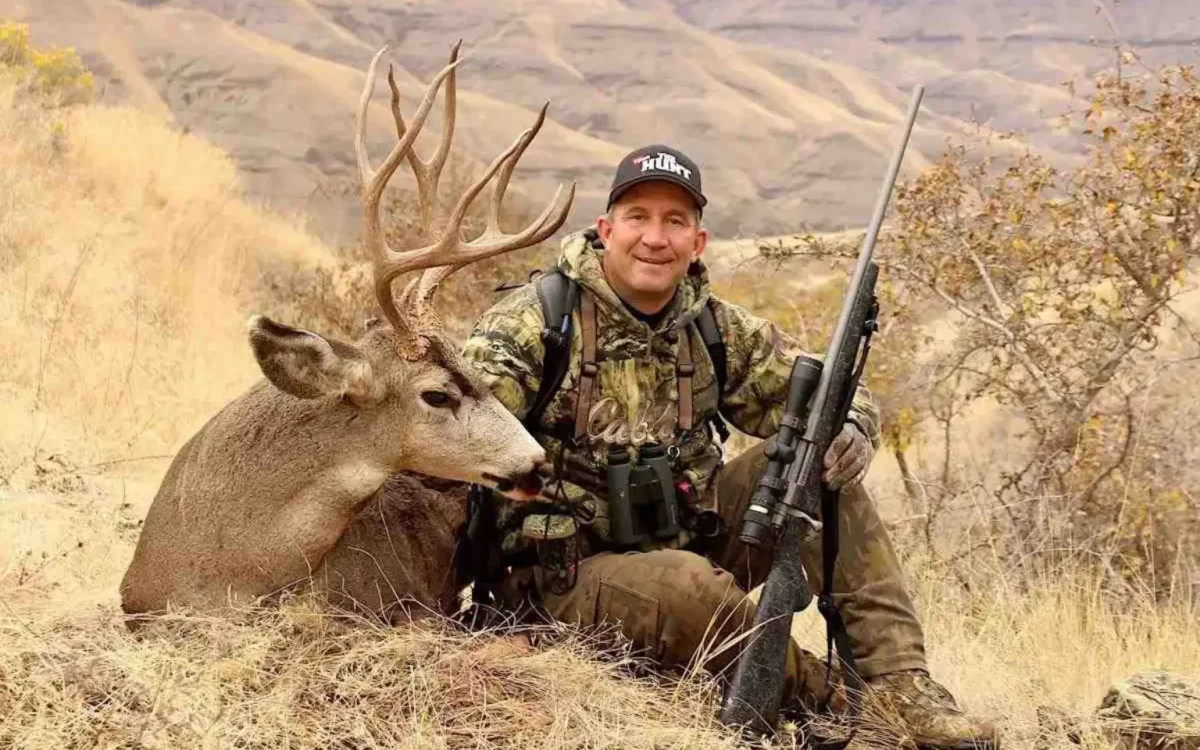


A mule deer hunt takes place within some of North America’s most distinctive western landscapes. Mule deer are closely associated with mountains, sagebrush country, grasslands, desert environments, and other open habitats across western North America.
For anyone researching mule deer hunting, understanding the species is an important starting point. Mule deer behavior, habitat, seasonal movements, population conditions, and hunting regulations can vary significantly between regions. Knowing these differences provides better context for understanding both mule deer and the wildlife management programs surrounding them.
Phone Number: 307-637-5495
Business Email: info@hunt-nation.com
What Is a Mule Deer?
Mule deer (Odocoileus hemionus) are native to western North America. Their name comes from their noticeably large ears, which resemble those of a mule.
Another recognizable characteristic is their movement. Mule deer often use a bounding gait known as stotting, particularly when moving quickly through uneven terrain.
Mule deer should not be confused with white-tailed deer. Although both are native North American deer species, they differ in physical characteristics, geographic distribution, habitat use, and behavior.
Where Do Mule Deer Live?
Location plays a major role when researching a mule deer hunt because these deer occupy a broad range of western habitats.
Depending on the region, mule deer can be associated with:
- Mountain and foothill environments
- Sagebrush landscapes
- Open woodland
- Grasslands
- Shrublands
- High desert environments
- Agricultural areas near suitable natural habitat
Mule deer distribution extends across significant portions of western North America. However, local population density and habitat conditions can vary considerably.
A destination should therefore be evaluated according to its own environment rather than assuming mule deer conditions are identical throughout their range.
Understanding Mule Deer Habitat
Quality habitat is essential to healthy mule deer populations.
Food, water, security cover, and seasonal ranges all influence how mule deer use a landscape. Habitat requirements can also change throughout the year as weather and vegetation conditions change.
Mule deer consume a variety of vegetation, including shrubs, grasses, and other plants. The availability and nutritional quality of these resources can affect the condition of individual animals and the broader population.
Wildfire, drought, development, invasive vegetation, and changes to migration corridors can also influence mule deer habitat. This is why habitat conservation remains an important part of long-term mule deer management.
Mule Deer Behavior and Seasonal Movement
Mule deer behavior is not constant throughout the year.
Seasonal changes can affect feeding patterns, social behavior, distribution, and movement between habitats. In some western populations, seasonal migration is especially important.
Individual herds may move between summer and winter ranges as weather and available forage change. These movements can cover substantial distances in some regions, while other populations may remain relatively localized.
The breeding period, commonly known as the rut, also changes deer behavior. Timing varies by region and environmental conditions, making location-specific information more useful than relying on a single general date.
Mule Deer Hunt Seasons and Regulations
Mule deer hunt regulations differ significantly depending on location.
State and provincial wildlife authorities establish rules according to local wildlife-management objectives. These regulations may address season dates, licensing, permits, harvest limits, reporting requirements, and other legal conditions.
Some areas may also manage individual mule deer populations differently based on herd size, habitat conditions, and conservation objectives.
Because regulations can change, anyone researching a mule deer hunt should verify current requirements directly with the wildlife authority responsible for the destination.
Information from previous seasons should never automatically be assumed to remain current.
Why Location Matters for Mule Deer Hunts
A mule deer hunt in one region may be very different from one somewhere else.
Western North America contains an enormous range of landscapes. Mule deer can inhabit everything from relatively dry desert country to mountainous environments.
Climate, elevation, vegetation, herd conditions, seasonal movements, and wildlife regulations can all change from one destination to another.
This makes destination-specific research particularly valuable. Rather than looking only for general information about mule deer hunting, readers should understand the environment and management conditions associated with the particular region they are researching.
Mule Deer vs. Whitetail Deer
Mule deer and white-tailed deer are sometimes discussed together, but they are distinct species with several recognizable differences.
Mule deer are known for their large ears and generally have a black-tipped tail. Whitetails are named for the prominent white underside of their tail.
Their geographic ranges also differ, although they overlap in some areas.
Habitat preferences and behavior can vary as well. Understanding which deer species is present in a particular region is important when researching wildlife regulations and management information.
Mule Deer Conservation and Management
Mule deer management involves much more than establishing hunting seasons.
Wildlife agencies monitor populations, habitat conditions, reproduction, mortality, migration, and other factors to make management decisions.
Habitat is particularly important.
Seasonal ranges and migration corridors can connect different areas that deer need throughout the year. Changes to one part of that landscape can potentially affect animals that depend on it during another season.
Conservation organizations, wildlife agencies, landowners, researchers, and other stakeholders may therefore work on projects involving habitat restoration, migration corridors, research, and population monitoring.
Why Migration Corridors Matter
Some mule deer populations make significant seasonal migrations between different ranges.
Research into these movements has helped wildlife managers better understand how deer interact with roads, development, fences, natural barriers, and changing landscapes.
Protecting important migration routes can consequently become part of broader mule deer conservation efforts.
Not every mule deer population follows the same migration pattern, however. This is another example of why regional information matters when discussing mule deer behavior.
Responsible Mule Deer Hunting Starts With Current Information
Anyone researching mule deer hunting should begin with accurate information from the appropriate wildlife authority.
Rules may differ according to state, province, management unit, property type, season, and other factors. Licensing or permit systems can also vary considerably.
Official wildlife agencies should be the primary source for current legal requirements.
Destination resources can provide useful information about local landscapes and deer populations, but regulations should always be verified before making decisions.
Frequently Asked Questions About Mule Deer Hunts
What is a mule deer hunt?
A mule deer hunt refers to regulated hunting of mule deer. The specific seasons, licenses, permits, and other requirements depend on the jurisdiction.
Where are mule deer found?
Mule deer primarily occur across western North America and occupy diverse environments ranging from mountains and forests to sagebrush and desert landscapes.
What is the difference between mule deer and whitetail deer?
Mule deer typically have larger ears and different tail characteristics from white-tailed deer. The two species also differ in distribution, behavior, and habitat use, although their ranges overlap in some areas.
Do mule deer migrate?
Some populations make substantial seasonal migrations between summer and winter ranges, while others have much shorter seasonal movements.
When is mule deer hunting season?
There is no single season that applies everywhere. Dates and regulations vary by jurisdiction and sometimes by individual management area. Always check the latest information from the responsible wildlife agency.
Why are mule deer populations managed?
Wildlife agencies manage mule deer populations to support long-term population sustainability while considering habitat conditions, environmental pressures, conservation objectives, and other regional factors.
Understanding Mule Deer Hunts in the Bigger Picture
A mule deer hunt is closely connected to the larger story of western wildlife management.
Mule deer depend on healthy habitat, seasonal ranges, and, for some populations, functioning migration corridors. At the same time, conditions differ substantially across their geographic range.
Understanding habitat, behavior, migration, conservation, and local regulations therefore provides important context for anyone researching mule deer hunting.
For destination-specific information, always compare current wildlife-agency regulations with reliable information about the particular region you are researching.
Learn More with Hunt Nation: https://www.hunt-nation.com/catalog-search/