
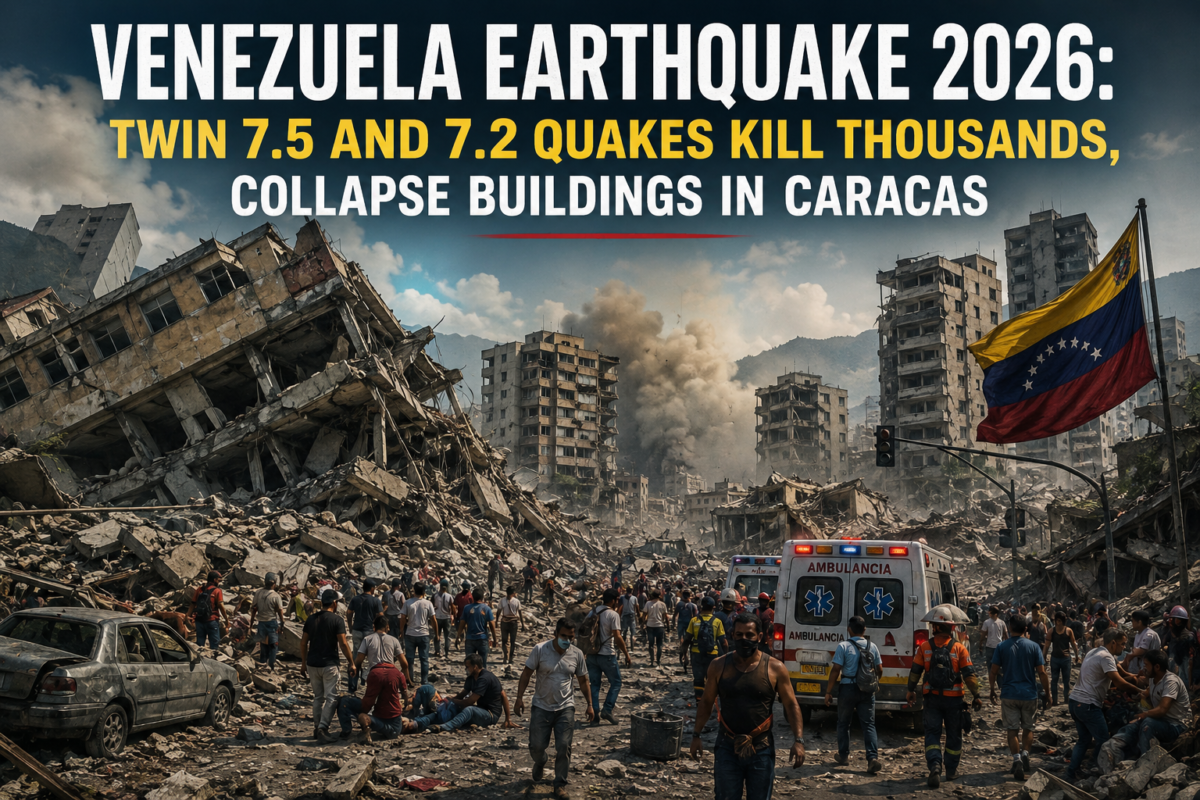


The Venezuela earthquake 2026 is one of the deadliest natural disasters to strike the Western Hemisphere in recent years. On June 24, 2026, two massive earthquakes struck northern Venezuela just 39 seconds apart, with magnitudes of 7.2 and 7.5, collapsing hundreds of buildings, killing more than 2,300 confirmed people, injuring over 11,200, and leaving tens of thousands still unaccounted for. The coastal state of La Guaira and the capital Caracas suffered catastrophic damage. Rescue teams from the United States, Argentina, Mexico, and dozens of other countries have been working around the clock through the rubble of nearly 59,000 damaged structures in what Venezuelan authorities and the United Nations are calling a humanitarian catastrophe of historic proportions.
What Happened: The Timeline of June 24
At 6:04 PM local time on Wednesday, June 24, 2026, the first earthquake struck. The U.S. Geological Survey recorded a magnitude 7.2 event centered near Yumare in Yaracuy state, approximately 176 miles west of Caracas, at a depth of 12.6 miles beneath the surface. As Britannica’s scientific account of the disaster confirmed, just 39 seconds later, a second, even more powerful earthquake measuring 7.5 in magnitude struck less than 6.2 miles from the first epicenter, at a shallower depth of just 6.2 miles, which intensified its surface impact significantly.
The two quakes together constitute what seismologists call an earthquake doublet, a relatively rare event in which two distinct earthquakes share nearly identical seismic waveforms, underground origin points, and magnitudes. Scientists believe the first earthquake increased stress along a nearby fault within the same Bocono fault system until the rocks gave way, triggering the second event within seconds. The result was a one-two punch of violent shaking that struck the same region twice before people had any chance to fully react to the first tremor.
As Al Jazeera reported from the scene, survivor Luis Alejandro Ruiz Garcia described receiving a Google earthquake alert a split second before the first tremors hit. “You could feel things falling. I saw one of my walls crack. I think it was one of the scariest moments of my life,” he said. Another survivor, Maria Alejandra, recalled the dust cloud that filled the air as her building cracked around her. “I only saw one family make it out,” she told Al Jazeera.
The Scale of Destruction
The physical damage from the Venezuela earthquake 2026 is staggering in scale. As detailed in reporting from multiple news organisations and the USGS, nearly 59,000 buildings were likely damaged or destroyed across northern Venezuela, based on satellite analysis conducted by researchers at Oregon State University. More than 250 structures were confirmed collapsed, with 189 completely leveled, according to Venezuelan government officials.
The hardest-hit areas include La Guaira state, just 10 miles north of central Caracas, where satellite images captured by spatial intelligence company Vantor showed entire city blocks reduced to rubble, with hotels, warehouses, and dozens of residential buildings collapsed or severely compromised. La Guaira has been formally declared a disaster zone. In Caracas itself, buildings in the Altamira neighbourhood and other districts collapsed, leaving residents buried under rubble or stranded in structures too damaged to safely inhabit.
Why the Buildings Fell
Experts have pointed to two compounding factors that made Venezuela’s urban infrastructure especially vulnerable. As seismologist Bo explained to Al Jazeera, many of the buildings in the hardest-hit Caracas neighbourhoods sit on soft sedimentary soil, which amplifies seismic wave intensity and increases the likelihood of collapse. Equally significant is the prevalence of informal housing throughout Venezuela, structures built outside formal regulatory frameworks with little or no seismic engineering, that had no realistic chance of surviving shaking of this magnitude.
Venezuela’s ongoing economic crisis has meant that building maintenance, regulatory enforcement, and infrastructure investment have been severely underfunded for years. Many older apartment buildings that might have been retrofitted or inspected in wealthier countries had received no structural attention for decades. The combination of poor soil conditions, informal construction, and aging uninspected buildings turned a devastating earthquake into a catastrophic one.
The Human Toll: Numbers That Keep Rising
The confirmed death toll has climbed steadily and painfully since the night of June 24. As Miyamoto International’s detailed engineering assessment tracked, the count rose from at least 188 in the first 24 hours, to 589 by June 26, past 1,700 by June 29, and to approximately 2,295 confirmed dead by July 1, 2026, according to National Assembly President Jorge Rodriguez. More than 11,200 people have been confirmed injured.
Behind those numbers is an even more sobering reality. Tens of thousands of people remain unaccounted for. As NPR’s one-week update reported, the United Nations humanitarian coordinator in Venezuela, Gianluca Rampolla, stated plainly that the death toll “will unavoidably and sadly keep on growing” as search and rescue operations continue and field assessments improve. The UN agreed with the Venezuelan government to procure 10,000 body bags for the operation, while simultaneously expressing hope that the final number would be smaller than that grim preparation implies.
The USGS PAGER predictive modelling system issued a red alert from the outset of the disaster, estimating from the very beginning that the death toll had a “substantial probability of exceeding 10,000.” As of early July, Sky News reported the UN was preparing for up to 10,000 deaths, with roughly 41,000 people still listed as missing.
The Humanitarian Crisis Unfolding
Beyond the immediate casualty figures, Venezuela is now facing a humanitarian crisis layered on top of a country that was already in severe distress. As NPR’s reporting described, up to 6.8 million people could be affected by the disaster, requiring shelter, clean water, sanitation, healthcare, and other relief items. The Pan American Health Organization’s survey of eight hospitals in the affected region found them overwhelmed and in urgent need of outside medical support.
Mirna Castillo, a Caracas resident displaced from her apartment building, captured the sense of chaos and abandonment that many survivors described to journalists in the days after the quake. “How are we going to live in a place that’s about to crack open?” she told NPR from the tent camp where she and her children were sleeping in a park. “It’s just one chaos after another.”
The Venezuelan government announced plans to open large displacement camps for residents left homeless by the destruction and pledged to begin constructing new housing quickly. Acting President Delcy Rodriguez said a presidential commission was assessing the state of damaged infrastructure. For many survivors waiting in tents or makeshift shelters, those promises remain distant against the immediate reality of having no home, no clean water, and no certainty about what happened to family members still unaccounted for.
The Economic Damage
The financial cost of the disaster is equally staggering. According to reporting from TRT World on UN economic estimates, the twin earthquakes wiped an estimated 6 percent of Venezuela’s GDP. The United Nations Development Programme put initial damage estimates at between US$4.7 billion and US$8.7 billion, while the United Nations Office for Disaster Risk Reduction estimated total direct damages at US$37 billion, covering destroyed housing, commercial buildings, schools, hospitals, and critical infrastructure including water systems, roads, ports, and energy networks. Verisk separately estimated over US$10 billion in economic losses for insurers and reinsurers.
The International Response
US Aid and Search and Rescue Teams
The United States moved quickly to respond. As CNN’s live coverage documented, the US State Department announced US$150 million in total aid, with US$100 million directed to a UN humanitarian fund for Venezuela and US$50 million to aid organisations already operating in the country. Two of the United States’ most capable urban search and rescue teams, from Fairfax County, Virginia and Los Angeles County, were deployed to Venezuela to assist with the rescue operation.
Mexico’s president Claudia Sheinbaum announced the deployment of a team of rescuers and health personnel from the Secretariat of National Defense. Argentina deployed a search and rescue team including a rescue dog that was photographed working through rubble in Caraballeda in La Guaira state. Dozens of countries across Latin America, Europe, and beyond sent teams, equipment, and financial assistance in the days immediately following the disaster.
World Vision and NGO Response
On the humanitarian aid side, organisations including World Vision, Americares, and dozens of others mobilised immediately. As World Vision’s on-the-ground reporting from affected communities described, teams in the Playa Grande neighbourhood of Catia La Mar in La Guaira state began providing emergency food, clean drinking water, hygiene supplies, psychosocial support, and child protection services within days of the disaster. World Vision also established Child-Friendly Spaces in affected Caracas communities, providing structured care for more than 60 children staying in a community chapel being used as a temporary shelter.
Americares dispatched its emergency response expert in Caracas to assess the most urgent health needs and coordinated with PAHO, the UN Office for the Coordination of Humanitarian Affairs, and local health partners. Workers at the Americares Global Distribution Center in Connecticut were photographed on June 25 preparing medicines, orthopedic supplies, and hygiene kits for shipment. As the organisation’s update described, hospitals surveyed by PAHO were overwhelmed and in need of immediate outside medical support.
The Science Behind the Earthquake Doublet
The rare phenomenon of an earthquake doublet has drawn significant scientific attention to the Venezuela disaster. As Britannica’s detailed scientific account explains, Venezuela sits within a broad transpressional boundary zone between the Caribbean Plate and the South American Plate. Northern Venezuela is crossed by the Bocono fault system, a complex network of strike-slip faults running southwest to northeast, which in turn converges with the east-west oriented San Sebastian fault system. These two fault systems together form the boundary between the two tectonic plates.
Seismologists believe the June 24 events occurred on two separate faults within the broader Bocono system, with the rupture along the first fault increasing stress along the second until it also gave way, all within 39 seconds. The earthquakes are described as the strongest to hit Venezuela since the San Narciso earthquake of 1900, which had a magnitude of 7.7.
The USGS separately assessed significant earthquake-triggered landslide hazards across the region, with its Ground Failure product estimating that landslides triggered by the earthquake sequence would likely be significant in both number and spatial extent. As the USGS Landslide Hazards program reported, this added an additional layer of risk to rescue operations in mountainous terrain across the affected region.
The Venezuelan Community in the United States
For many Americans, this disaster is not a distant foreign story. As CNN reported, the Venezuelan community in Union City, New Jersey, one of the largest Venezuelan diaspora communities in the United States, was described as “reeling” in the immediate aftermath of the disaster. An estimated 700,000 Venezuelan-born residents live in the United States, with significant communities in Florida, Texas, New York, and New Jersey. For these families, the earthquake was not simply a news event but a personal crisis involving loved ones in the affected regions.
Phone lines and internet connectivity were disrupted across parts of northern Venezuela in the hours immediately following the quakes, making contact with family members extremely difficult for diaspora communities abroad. US-based Venezuelans organised community gatherings, fundraising events, and coordinated supply drives in the days after the disaster to support relief efforts.
How to Help Venezuela Earthquake Victims
Several verified, well-established humanitarian organisations are currently accepting donations specifically for Venezuela earthquake relief. World Vision’s Venezuela earthquake response page provides direct donation options and regular updates on how funds are being used in affected communities. Americares, CARE, and the International Federation of Red Cross and Red Crescent Societies are also active in the relief operation and accept direct donations toward Venezuela-specific emergency response.
For anyone wishing to help from the United States, financial donations to established organisations are almost always more effective than attempting to send physical goods directly, since aid organisations have the logistics networks to get supplies where they are most needed most efficiently. If you have Venezuelan family or friends in affected areas and are trying to make contact, the International Committee of the Red Cross maintains a family tracing and messaging service that operates during major disasters.
Frequently Asked Questions (FAQs)
Q1. How strong was the Venezuela earthquake on June 24 2026?
Two earthquakes struck Venezuela on June 24, 2026, measuring 7.2 and 7.5 in magnitude, occurring just 39 seconds apart. The epicenters were in Yaracuy state, approximately 176 miles west of Caracas. The USGS described both events as among the strongest to hit Venezuela since 1900 and issued a red PAGER alert predicting thousands of casualties from the outset.
Q2. How many people died in the Venezuela earthquake 2026?
As of July 1, 2026, approximately 2,295 deaths had been confirmed by Venezuelan authorities, with more than 11,200 people injured. Tens of thousands of people remain unaccounted for. The USGS and UN have both stated the death toll is expected to continue rising as search and recovery operations reach additional collapsed structures, with some projections suggesting the final toll could exceed 10,000.
Q3. Where was the worst damage from the Venezuela earthquake?
The hardest-hit areas were La Guaira state on Venezuela’s Caribbean coast, just 10 miles north of Caracas, and parts of the capital Caracas itself, particularly the Altamira neighbourhood. La Guaira has been declared a disaster zone. Other affected states include Aragua, Carabobo, Miranda, and Trujillo. Satellite analysis estimated approximately 58,870 buildings were likely damaged or destroyed across the region.
Q4. Did the Venezuela earthquake cause a tsunami?
A tsunami alert was issued shortly after the earthquakes on June 24, 2026, as a precautionary measure given the proximity of the epicenters to the Caribbean coast. The alert was later cancelled. No tsunami materialised, and no ongoing tsunami warning has been in effect since the initial hours after the quakes.
Q5. What aid is the United States sending to Venezuela?
The United States announced US$150 million in total humanitarian aid, with US$100 million directed to a UN humanitarian fund for Venezuela and US$50 million to aid organisations already working in the country. The US also deployed two urban search and rescue teams, from Fairfax County, Virginia and Los Angeles County, to assist with rescue operations in collapsed buildings.
Q6. What caused such an unusual earthquake doublet to strike Venezuela?
Venezuela sits at the boundary between the Caribbean Plate and the South American Plate, crossed by the complex Bocono fault system. Seismologists believe the first 7.2 magnitude earthquake increased stress along a nearby, shallower fault within the same system until it also ruptured, producing the 7.5 magnitude second earthquake just 39 seconds later. This relatively rare phenomenon, called an earthquake doublet, caused the sustained violent shaking that proved so destructive to Venezuela’s building stock.
The Venezuela earthquake 2026 has left a nation already struggling under years of economic and political crisis facing the worst natural disaster it has experienced in over a century. As rescue teams continue their exhausting work through the rubble of thousands of collapsed structures, and as the full extent of the human and economic toll becomes clearer in the weeks ahead, the response from the international community, including the United States, offers at least some basis for hope that Venezuela will not face this alone. For more world news and breaking stories as they develop, keep reading Weblogs4u.