
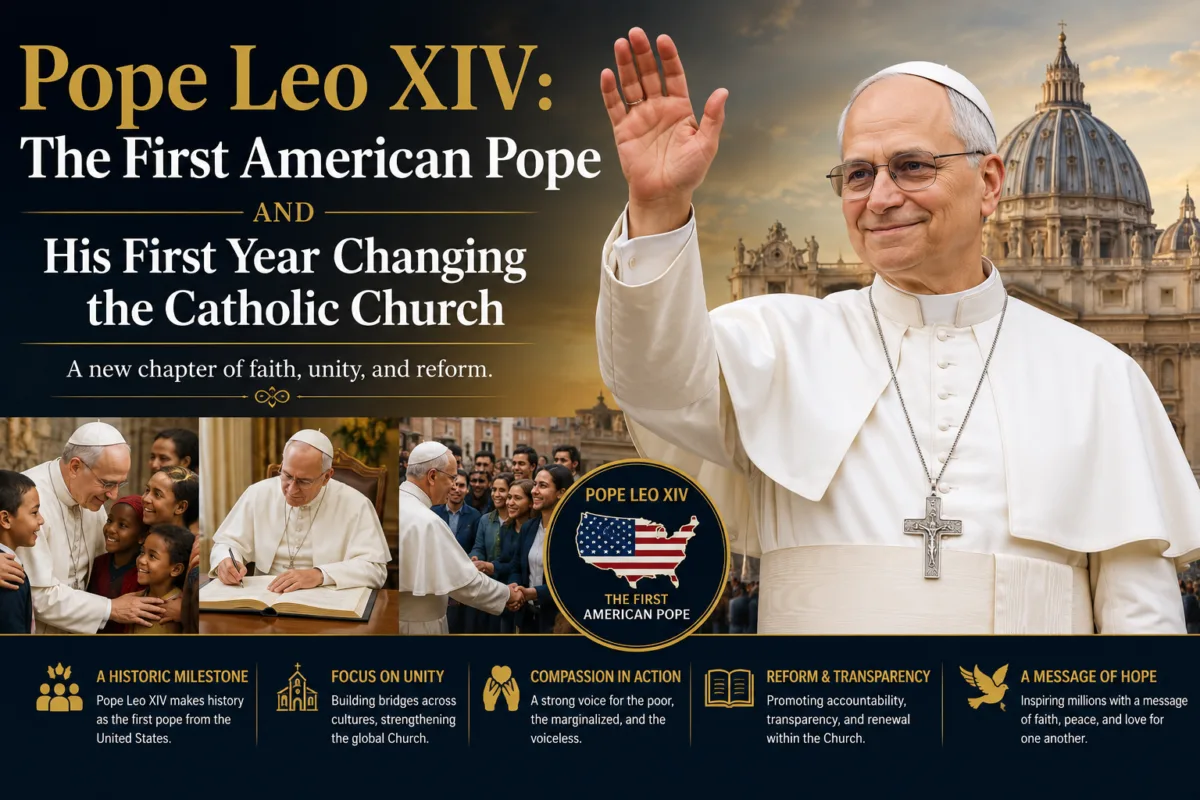


Pope Leo XIV is not just a religious story. He is an American story. On May 8, 2025, a 69-year-old man from the South Side of Chicago stepped out onto the balcony of St. Peter’s Basilica in Rome and became, in that single moment, the most powerful religious figure on earth and the first American pope in the two-thousand-year history of the Catholic Church. His name was Robert Francis Prevost. The world now calls him Pope Leo XIV. And right now, as he completes a major visit to Spain this week, his first year in office is drawing a picture of a papacy that is quieter than many expected but more consequential than most predicted.
Who Is Pope Leo XIV? The Man Before the White Smoke
Before May 8, 2025, most Americans had never heard of Robert Prevost. That is partly by design. He spent most of his adult life working far from the spotlight, in places far from home, doing work that rarely makes headlines.
He was born on September 14, 1955, in Chicago, Illinois, and grew up in the south suburban community of Dolton. His parents, Louis and Mildred Prevost, were a school principal and a librarian. Neighbors who knew the family described them as deeply devout, the kind of Catholics who did not just go to Mass on Sundays but organized their entire lives around their faith.
The Journey from Chicago to Peru
Prevost entered the Augustinian religious order in 1977 at the age of 22. He made his final vows four years later and went on to study canon law in Rome, earning his doctorate from the Pontifical University of St. Thomas Aquinas in 1987. What happened next is what separates him from almost every other Church leader of his generation.
He went to Peru. Not for a visit, not for a short mission trip, but for decades. He spent the majority of his working life in Peru as a missionary priest, eventually becoming Bishop of Chiclayo. He became a naturalized Peruvian citizen. He learned to think, pray, and lead in the context of South American poverty and complexity, far from the centers of Catholic power in Europe and North America.
This background shaped everything about him. When other cardinals debated the problems of the global church from their offices in Rome, Prevost had spent years sitting with them in the places where those problems were lived out every single day.
Rising Inside the Vatican
Pope Francis noticed him. In 2023, Francis made Prevost a cardinal and appointed him to lead the Dicastery for Bishops, one of the most influential positions inside the Vatican. This office is responsible for evaluating and recommending bishops for appointments around the world. Running it well requires extraordinary judgment, discretion, and the ability to navigate competing interests without making enemies. Prevost did it quietly and effectively.
When Francis died in April 2025, Prevost entered the conclave as a serious but not heavily publicized candidate. According to a detailed account later published by journalists Gerard O’Connell and Elizabeth Pike, the Italian favorite withdrew from the race during the balloting inside the Sistine Chapel, and support shifted toward Prevost. On the fourth round of voting, white smoke rose above the Vatican. The world had a new pope. For more on what that moment looked like on American news, CBS News documented the story in detail.
Why He Chose the Name Leo XIV
The choice of a papal name is never accidental. It is a statement of intention and a signal to the Church about what the new pope sees as his mission.
Leo is one of the great names in Catholic history. The most famous was Pope Leo XIII, who led the Church from 1878 to 1903 and is best remembered for the encyclical Rerum Novarum, a foundational document in Catholic social teaching that addressed workers’ rights, poverty, and the relationship between labor and capital during the Industrial Revolution.
By choosing Leo XIV, Prevost was signaling a papacy rooted in social justice, the rights of the poor and the marginalized, and the Church’s responsibility to engage with the major challenges of modern society, including economic inequality, migration, and the rise of artificial intelligence. That signal has proven accurate.
His First Year: What Pope Leo XIV Actually Did
Many observers expected a quiet, cautious first year from a man known for deliberate, measured decision-making. What they got was something more active than that, even if it arrived without fanfare.
His First Major Teaching Document
In September 2025, just four months into his papacy, Leo XIV signed his first apostolic exhortation, titled Dilexi Te, which translates as I Have Loved You. The document focused on the Christian obligation to care for the poor and issued a sharp critique of what he called the injustice of the global market system. It was the kind of language that made some wealthy Western Catholics uncomfortable and gave enormous hope to Catholics in the Global South. It was also unmistakably in the tradition of the Leo whose name he had chosen.
His First International Journey
In late November 2025, Pope Leo XIV made his first international trip as pope, traveling to Turkey and Lebanon to mark the 1,700th anniversary of the Council of Nicaea. The choice of destination was itself a message. Turkey and Lebanon are both countries where Christians live as minorities alongside Muslim majorities, and both have faced enormous political and social stress in recent years. Leo spoke about the value of interfaith friendship and said the mutual respect he witnessed between Christians and Muslims in those countries could be a model for people in North America and Europe.
The AI Question
One of the most watched aspects of Leo XIV’s papacy has been his engagement with artificial intelligence. He warned priests against using AI to write their sermons, saying that true faith transmission requires human presence and genuine prayer. He is expected to release a major encyclical on AI and human dignity later in 2026, which would make him the first pope to issue a major teaching document specifically addressing artificial intelligence. Given how rapidly AI is reshaping work, relationships, and society, this document will be watched closely far beyond Catholic circles. For context on the broader AI story unfolding right now in America, see our recent deep-dive on the AI infrastructure crisis.
January 2026: Closing the Jubilee Year
On January 6, 2026, Pope Leo XIV formally closed the Holy Door of St. Peter’s Basilica, marking the end of the 2025 Jubilee Year. In his homily, he criticized what he described as a distorted economy that tries to profit from every human desire, including the desire for joy and spiritual fulfillment. The critique landed sharply in a world where wellness and spiritual content have become billion-dollar industries.
His First Anniversary and Spain Visit
On May 8, 2026, Pope Leo XIV marked his first full year as pope by visiting Naples and the Pontifical Shrine of the Blessed Virgin of the Rosary in Pompeii. Then, starting June 6, 2026, he began a seven-day apostolic journey to Spain, the first papal visit to that country in 15 years. As PBS NewsHour reported, he arrived at Madrid’s Barajas Airport on June 6 and was received by King Felipe VI and Queen Letizia at the Royal Palace. His message to Spain was direct: stop fanning the flames of polarization. The country is dealing with deep political divisions, and Leo spoke about the Church’s role in building bridges rather than reinforcing divisions.
He is scheduled to visit Madrid, Barcelona, Gran Canaria, and Tenerife before his journey concludes on June 12, 2026. One of the highlights of the Barcelona stop is his participation in ceremonies connected to the Sagrada Familia, Antoni Gaudi’s legendary unfinished basilica, where the Tower of Jesus Christ was recently completed.
What Makes This Pope Different From Those Before Him
Every pope brings something new. But Leo XIV brings something that has genuinely never existed before in 2,000 years of Church history: the perspective of someone formed in the United States, the most powerful country in the world, who then spent most of his adult life working in one of its poorer, more vulnerable neighbors.
Not Afraid to Speak About Migration
One of the most politically charged things Leo XIV has done is speak directly about the rights of migrants and immigrants, including in the United States. Pope Francis had made this a signature issue of his papacy. Leo XIV has continued it, and he does so as someone who is both American and Peruvian, who has personally witnessed what migration means to real families. He has demanded dignified treatment for migrants in his native country, at a moment when immigration is one of the most divisive political issues in American life. That takes a specific kind of courage.
His Style of Leadership
People who know him describe Leo XIV as someone who takes his time and listens before speaking or acting. In an era of instant reactions and social media outrage cycles, this is a genuinely distinctive quality in a world leader. His first year has been marked by measured, deliberate choices rather than dramatic gestures, and by a consistent focus on the same themes: the poor, the marginalized, peace, and the responsible use of technology.
As Britannica notes in his biography, he brings a reputation for being a fair and deft administrator and a political moderate who is expected to continue the agenda of his predecessor while bringing his own distinctive voice to the papacy.
Why Americans Should Pay Attention
For American Catholics, this papacy is deeply personal in a way that no other in history has been. For the first time, the pope is someone who grew up on American streets, went to American schools, and carries an American passport. When he speaks about the challenges of modern life, he is speaking with some firsthand knowledge of what life in America actually looks like.
But even for Americans who are not Catholic, this story matters. The Catholic Church has 1.4 billion members worldwide. The pope is one of the most listened-to moral voices on the planet, with influence in politics, international relations, social policy, and culture that extends far beyond any single religious community. Having an American in that role is a genuinely historic shift in how the world sees the United States.
And for the 70 million Catholics in America specifically, this is a moment of enormous pride and complicated responsibility. Their pope is one of them, but he has spent his life reminding people like him that their comfort and privilege come with obligations they cannot ignore.
Frequently Asked Questions (FAQs)
Q1. Who is Pope Leo XIV?
Pope Leo XIV is the leader of the Roman Catholic Church, elected on May 8, 2025. Born Robert Francis Prevost in Chicago, Illinois in 1955, he is the first American pope in the two-thousand-year history of the Catholic Church. He is also a naturalized citizen of Peru, where he spent decades as a missionary.
Q2. Where did Pope Leo XIV grow up?
He grew up in Dolton, a south suburb of Chicago, Illinois. His family was deeply involved in their local Catholic parish. He entered the Augustinian religious order at 22 and later pursued advanced studies in Rome before beginning his missionary work in Peru.
Q3. Why is Pope Leo XIV in Spain right now in June 2026?
Pope Leo XIV began a seven-day apostolic journey to Spain on June 6, 2026, the first papal visit to Spain in 15 years. The trip covers Madrid, Barcelona, Gran Canaria, and Tenerife. Key themes of the visit include political polarization, migration, and faith in modern European society. He is also participating in ceremonies at the Sagrada Familia in Barcelona.
Q4. What has Pope Leo XIV said about artificial intelligence?
He has warned priests against using AI to write their sermons, emphasizing that authentic faith transmission requires genuine human presence and prayer. He is expected to release a major encyclical, or formal teaching document, specifically on AI and human dignity later in 2026. This would be the first major papal teaching document dedicated to artificial intelligence.
Q5. How many Catholics are there in the United States?
There are approximately 70 million Catholics in the United States, making it one of the largest Catholic populations in the world. Globally, the Catholic Church has approximately 1.4 billion members across every continent.
Q6. Where can I follow Pope Leo XIV’s official statements and travels?
The official source for all papal statements, travels, and documents is the Vatican’s official website. For US news coverage, CBS News, PBS NewsHour, and the National Catholic Reporter all maintain dedicated coverage of Pope Leo XIV’s papacy.
Pope Leo XIV is one year into a papacy that is already proving more consequential than many expected. The first American pope in history has spoken clearly about poverty, migration, technology, and human dignity during a year when all of those topics sit at the center of global debate. As he concludes his Spain visit this week and prepares for a major consistory later in June, the world is watching what this quiet, deliberate man from Chicago’s South Side will do next. For more world news and the stories shaping life in America and beyond, keep reading Weblogs4u.