
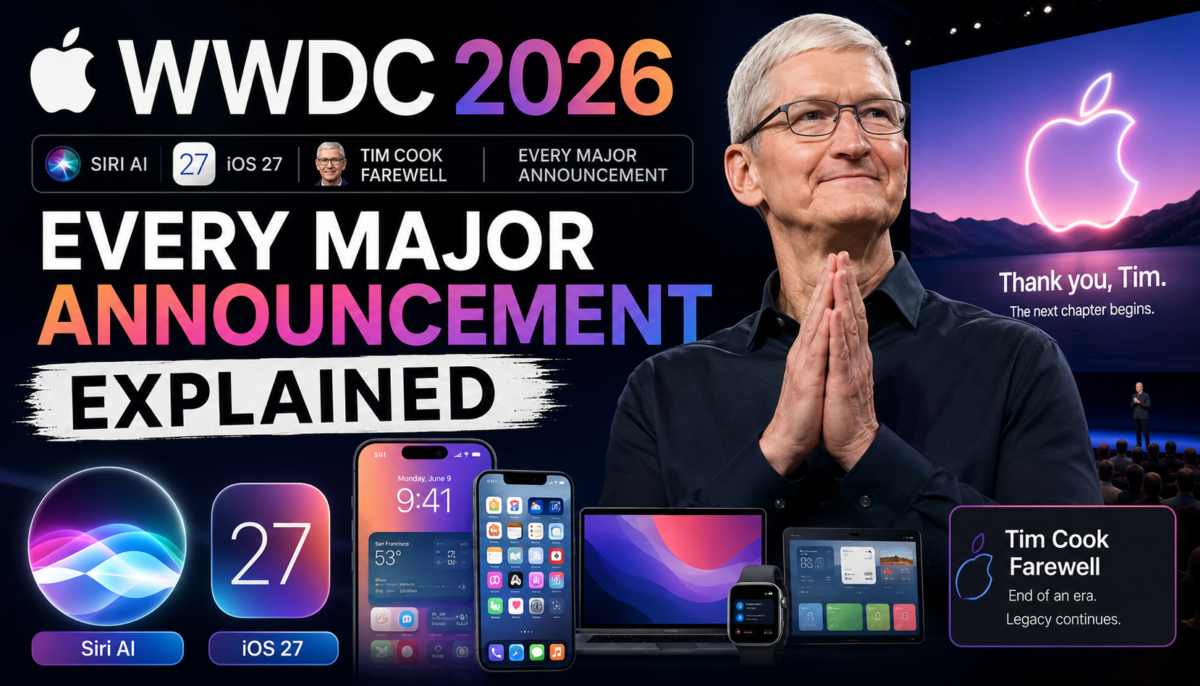


Apple WWDC 2026 was one of the most emotionally charged and technically significant developer conferences the company has ever held. On June 8, at Apple Park in Cupertino, California, CEO Tim Cook walked onto the stage for almost certainly the last time as Apple’s chief executive and unveiled a wave of announcements that the company had been building toward for two years. Siri got a complete rebuild powered by Google Gemini. iOS 27 arrived with meaningful speed improvements and major new features. macOS got a new name and dropped Intel support for good. And in a moment that the room went noticeably quiet for, Tim Cook said goodbye. Here is everything that happened and what it means for the hundreds of millions of people who use Apple devices every day.
The Tim Cook Farewell: The End of an Era at Apple
Before getting into the features and announcements, the human story at the centre of WWDC 2026 deserves to be told properly. Tim Cook has been Apple’s CEO since August 2011, when he took over from Steve Jobs. In that time, he has overseen the iPhone’s rise to global dominance, the creation of the Apple Watch, the AirPods phenomenon, Apple Silicon, and the company’s growth from a valuable company into the most valuable company in the history of the stock market.
At WWDC 2026, Cook opened proceedings with a video compilation featuring friends of Apple and celebrity fans including Harrison Ford, Jimmy Fallon, Whoopi Goldberg, Druski, and Michael B. Jordan. He joked with the crowd, looked visibly moved by the reception, and delivered the keynote with the ease that comes from having done it dozens of times. At the close of the event, he delivered a short personal message that acknowledged the transition ahead.
His words, captured by TechCrunch’s full WWDC coverage, were: “Over the years, you have helped people connect, create, learn, and experience the world in extraordinary new ways, and with the incredible capabilities we introduce today, and so many more still to come, I truly believe the best is still ahead at Apple. Getting the best products in the world to deliver experiences that enrich people’s lives has always been our North Star. It’s been the honor of a lifetime.” Cook wipes a tear. The room went quiet in a way that product reveals never produce.
John Ternus, the Senior Vice President of Hardware Engineering who will take over as CEO on September 1, 2026, did not appear during the keynote. Cook finished the show the way he started it, as the face of Apple. That choice was deliberate and right.
The Biggest Announcement: Siri AI Is Finally Real
If there is one story at the centre of WWDC 2026, it is Siri. For two years, Apple promised a rebuilt, genuinely intelligent version of Siri that could compete with ChatGPT, Google Gemini, and the growing wave of AI assistants that had made the original Siri look embarrassingly outdated. Year after year, features were promised and delayed or delivered in forms that failed to impress.
At WWDC 2026, Apple finally delivered. The new Siri AI is not a cosmetic upgrade to the assistant you have been using for 15 years. It is a complete rebuild from the ground up, running on a custom Google Gemini model that Apple is calling Apple Foundation Models on Cloud.
Powered by Google Gemini: An Unexpected Partnership
The detail that surprised most observers was the engine under the hood. As CNBC’s live coverage documented, Apple has built its cloud AI on a collaboration with Google, producing what it calls Apple Foundation Models on Cloud. The AFM Cloud Pro model, designed for the most demanding tasks, is comparable in quality to Gemini Frontier models and runs on Nvidia GPUs in Google’s cloud infrastructure. This is a striking partnership between two companies that compete fiercely in smartphones and services, and it signals that Apple made a pragmatic decision: rather than fall further behind while building everything internally, it partnered with the company whose AI infrastructure was ready to power the experience Apple needed to deliver.
Apple was emphatic about privacy throughout the presentation. Craig Federighi, Apple’s Senior Vice President of Software Engineering, stated plainly: “We believe privacy in AI is non-negotiable. Data is only used to execute the task at hand.” The architecture is designed so that even when Siri uses cloud models for complex tasks, the data handling follows Apple’s established privacy principles.
What Siri AI Can Actually Do Now
The new Siri AI has three capabilities that are genuinely new and meaningful for everyday users.
First, it is now a standalone app. You can open Siri AI as its own application and have extended, multi-turn conversations with it the way you would with ChatGPT or Gemini. This is a fundamental shift from the old Siri, which was primarily triggered by voice commands and existed as a system overlay rather than a dedicated application.
Second, it has real-time screen awareness. Siri AI can see what is on your screen and understand the context of what you are doing. If you are reading an article and ask Siri a question about something you just read, it knows what you read. If you are looking at a photo and ask about the location, it can analyse the image. This on-screen awareness is the feature that makes Siri AI feel like it understands your context rather than just responding to isolated commands.
Third, it has deep system-wide personal context. Siri AI can now draw on your calendar, your messages, your emails, your notes, and your history to give answers that are genuinely personalised to your life rather than generic responses. Ask it when you are free next week and it knows your schedule. Ask it what that restaurant recommendation was from the conversation last month and it can find it.
Cross-App Context Awareness
One of the specific features called out by Tom’s Guide in its comprehensive WWDC recap, is cross-app context awareness, which allows Siri AI to pull together information from multiple apps to answer a question. If you ask it to find that email your colleague sent about the project and add the deadline to your calendar, it can reach across Mail and Calendar and complete both steps in one interaction. This is the kind of agentic behaviour that makes AI assistants genuinely useful rather than just impressive in demos.
iOS 27: Everything Your iPhone Is Getting This Fall
iOS 27 was officially announced at WWDC 2026 and will be available as a developer beta immediately, with public beta access expected next month and the full release arriving in September 2026. The good news for existing iPhone owners is that iOS 27 supports every device that ran iOS 26, meaning iPhone 11 and later, with no cuts to the supported device list.
30 Percent Faster App Launches
The headline performance improvement in iOS 27 is a 30 percent increase in app launch speed, according to Memeburn’s detailed WWDC breakdown. Apple tested this on iPhone 11 Pro Max and iPhone 15 using a 50,000-asset photos library, comparing iOS 26.4.2 performance against the prerelease iOS 27. For users who have older iPhones that are still supported, this improvement alone could meaningfully change how responsive the device feels day to day.
Apple Wallet Gets Visual Intelligence
The Apple Wallet app is getting a significant upgrade through Visual Intelligence. As Tom’s Guide specifically highlighted, users will be able to scan barcodes or QR codes on physical membership cards, event tickets, and rewards passes using the camera, and Wallet will automatically create a fully customised digital version of that card. For anyone who carries a wallet full of loyalty cards, gym passes, and membership cards, this is a genuinely useful addition.
Major Parental Controls Overhaul
One of the most substantive non-AI announcements in iOS 27 is a comprehensive overhaul of parental controls. Apple is introducing mandatory child accounts for users under 13, which will require parental setup and approval before the account can be used. Parents also gain new website-approval tools in Safari, allowing them to review and explicitly permit or block specific sites rather than relying on broad category filters.
For American families navigating the challenge of children and screen time, this update is directly responsive to years of criticism that Apple’s parental control tools were not powerful or granular enough. The mandatory child account requirement in particular closes a loophole where children could simply set up adult accounts to bypass restrictions.
Safari Tab Management and Password Updates
Safari is getting two quality-of-life improvements that many users have been requesting for years. Tab management has been redesigned to make it easier to organise, group, and switch between large numbers of open tabs. And password updating is now a one-tap process when sites prompt you to change credentials, eliminating the multi-step friction that made many people delay updating passwords they knew should be changed.
macOS 27 Golden Gate: The End of Intel
The desktop operating system update was announced as macOS Golden Gate, continuing Apple’s tradition of naming Mac operating systems after California landmarks. The headline change is one that has been coming for several years: macOS 27 drops Intel support entirely.
Every Mac sold since late 2020 runs Apple Silicon, which is Apple’s own chip architecture developed in-house. The transition away from Intel has been one of the most successful platform transitions in Apple’s history, delivering dramatic performance and battery life improvements across the Mac lineup. Dropping Intel support in macOS 27 allows Apple’s software team to stop maintaining compatibility layers for the older architecture and focus entirely on optimising for Apple Silicon.
For anyone still using a pre-2020 Intel Mac, this means macOS 27 will not be available, and the device will remain on macOS 26 as its final supported operating system. The Liquid Glass design language introduced in recent versions of macOS has been refined with a new opacity slider that gives users more control over the translucency effects that define the visual style.
The Foldable iPhone Is Coming: Hidden Clues in iOS 27
Apple did not announce a foldable iPhone at WWDC 2026. But the clues buried inside the iOS 27 developer beta are attracting enormous attention from the tech community and represent one of the most talked-about stories to come out of the week.
Researcher @M1Astra dug through files within the iOS 27 developer beta and found references to things like “foldState” and “angleDegrees” that are not present in any current iPhone and clearly relate to the mechanical states a foldable device can occupy. As TechCrunch noted in its coverage, new foldable layout APIs are also present in the developer frameworks, quietly laying the groundwork for third-party apps to support a device that Apple has not yet announced publicly.
Apple holds its annual iPhone event in September. John Ternus, the incoming CEO, takes over on September 1. The timing of a major new product category launch alongside a CEO transition would be a significant moment for both the product and the executive leading Apple into its next era. The foldable iPhone is not confirmed, but the evidence in iOS 27 is more substantial than it has been at any previous point.
Apple Intelligence Expands Across the Ecosystem
Beyond Siri AI, Apple Intelligence is expanding to cover more of the device experience across all of Apple’s platforms. The Home app is getting smarter notifications for security camera alerts, using AI to distinguish between meaningful events and routine motion. Video descriptions powered by Apple Intelligence are now available for stored security videos, providing automatic text summaries of what happened in recorded footage.
AirPods are getting customisable sound profiles, moving beyond the fixed audio tuning that has characterised Apple’s earbuds since their introduction. Users will be able to personalise their audio experience in ways that go beyond the existing Adaptive Audio and Transparency mode settings.
For Developers: App Intents Is Now Mandatory
The most consequential announcement for the developer community is one that most consumers will not notice directly. As Lushbinary’s developer-focused WWDC breakdown explained, Apple gave SiriKit a formal deprecation notice at WWDC 2026 and made the expanded App Intents framework the only way for Siri to interact with third-party apps going forward. This is a significant architectural change that requires every app developer to migrate their Siri integrations. Apple has signalled roughly a two to three year support window for existing SiriKit implementations, but the message is clear: App Intents is the future, and developers should start migrating now.
Xcode 27, the development environment Apple engineers and third-party developers use to build apps, now includes on-device AI code completion, bringing Apple’s development tools into direct competition with GitHub Copilot and similar AI coding assistants that have become standard in the wider developer community.
Is Apple Back in the AI Race?
The honest answer is: yes, meaningfully more than it was before WWDC 2026, but with significant caveats.
The new Siri AI is a genuine product in a way that the old Siri never quite was at the intelligence level people expected. The Google Gemini partnership delivers real capability rather than promises. The on-screen awareness, cross-app context, and standalone app experience are features that match or exceed what many competing AI assistants offer. For the hundreds of millions of iPhone users who have never opened ChatGPT or Gemini on their phone, Siri AI will be their primary experience of what modern AI assistants can do, and it is a good one.
The caveats are real too. As Tom’s Guide AI editor Amanda Caswell noted in her WWDC coverage, the question is whether the new Siri is “too late after ChatGPT and other AI services blew past Apple in the last two years.” The AI landscape has moved extremely fast, as explored in our piece on how America’s AI infrastructure is being strained by the pace of demand. Apple is no longer setting the pace in this space. The question now is whether it can hold its position as the best AI experience for people already inside the Apple ecosystem, and on that front, WWDC 2026 gave a much more convincing answer than the company has managed in a while.
Frequently Asked Questions (FAQs)
Q1. What is Siri AI and how is it different from the old Siri?
Siri AI is Apple’s completely rebuilt voice and intelligence assistant, announced at WWDC 2026 and arriving in iOS 27 this fall. Unlike the old Siri, which existed as a system overlay and responded to isolated voice commands, Siri AI is a standalone app powered by a custom Google Gemini model. It has real-time screen awareness, deep personal context across all your Apple apps, cross-app capability, and full conversational ability over multiple turns.
Q2. Which iPhones will get iOS 27?
iOS 27 supports every iPhone that ran iOS 26, which means iPhone 11 and later. Apple did not cut any devices from the supported list for iOS 27, which is good news for anyone with an older iPhone that is still running well. The update will be available as a public beta next month and as the full release in September 2026.
Q3. Why did Apple partner with Google for Siri AI?
Apple partnered with Google to power the cloud AI capabilities in the new Siri AI because Google’s Gemini models provide the level of intelligence Apple needed to deliver a genuinely competitive AI assistant. Rather than fall further behind competitors while building everything internally, Apple made a pragmatic decision to collaborate with the company whose AI infrastructure was ready to power the experience. Apple maintains that data handling follows its privacy principles throughout the partnership.
Q4. Who is replacing Tim Cook as Apple CEO?
John Ternus, currently Apple’s Senior Vice President of Hardware Engineering, will become Apple’s CEO on September 1, 2026. Ternus did not appear during the WWDC 2026 keynote. Tim Cook delivered the event as usual and closed with a personal farewell message that acknowledged the transition ahead.
Q5. Is Apple making a foldable iPhone?
Apple has not officially announced a foldable iPhone. However, researchers digging through the iOS 27 developer beta found references including the terms foldState and angleDegrees, as well as new foldable layout APIs in the developer frameworks. These are widely interpreted as groundwork for a foldable device. Apple’s annual iPhone event takes place in September, which is when any official announcement would most likely be made.
Q6. What is macOS Golden Gate and which Macs will support it?
macOS Golden Gate is the name for macOS 27, the latest version of Apple’s desktop operating system. It drops support for Intel-based Macs entirely, meaning only Macs with Apple Silicon chips released from late 2020 onward will be able to run it. The update refines the Liquid Glass visual design with a new opacity slider and brings Apple Intelligence features to the Mac platform.
Apple WWDC 2026 delivered on most of what it promised and more than a few things nobody expected. Siri AI is finally a product worth using. iOS 27 is a meaningful update that respects existing hardware. Tim Cook closed out one of the most consequential tenures in technology history with grace and a tear. And buried in the developer beta files, the foldable iPhone waits to be announced. For the hundreds of millions of people who use Apple devices every day, this was a good week. For everyone watching the global technology race, it was a reminder that even a company that fell behind can find its way back to the front of the conversation when it stops making excuses and starts shipping. For more technology news and the stories shaping the world in 2026, keep reading Weblogs4u.