

While Silicon Valley and Beijing fight for dominance in the artificial intelligence race, a city in the desert is making a move that the rest of the world is starting to take very seriously. On June 11, 2026, Sheikh Hamdan bin Mohammed bin Rashid Al Maktoum, Crown Prince of Dubai and Chairman of Dubai’s Higher Committee for Future Technology Development, made one of the most ambitious technology declarations of the year. His goal, stated plainly: to make Dubai the world’s leading AI hub. The plan behind that goal is detailed, funded, and already in motion, with targets that would have seemed like science fiction just five years ago.
What Sheikh Hamdan Actually Said and Why It Matters
This was not a vague vision statement or a conference keynote designed to generate headlines. The announcement came out of a formal committee meeting at which Sheikh Hamdan reviewed specific programmes, approved concrete initiatives, and set measurable targets with real deadlines attached to them.
His words, as reported by The National, were direct: “Our goal is for Dubai to become the world’s leading hub for developing and deploying advanced AI solutions, with the private sector playing a central role in driving this transformation. We aim to turn these opportunities into tangible economic outcomes, create new pathways for growth, and enhance the emirate’s global competitiveness.”
That combination of private sector focus, economic outcomes, and global competitiveness framing tells you a great deal about how Dubai is approaching this. This is not a government research project. It is a commercial strategy designed to make Dubai the place where the world’s AI economy does business.
The Numbers Behind the Plan: What Dubai Is Actually Committing To
The most striking part of the announcement was the specificity of its targets. Anyone can say they want to be a global AI leader. Dubai is saying exactly what that looks like in measurable terms and putting deadlines on it.
295,000 Companies to Be Empowered With AI
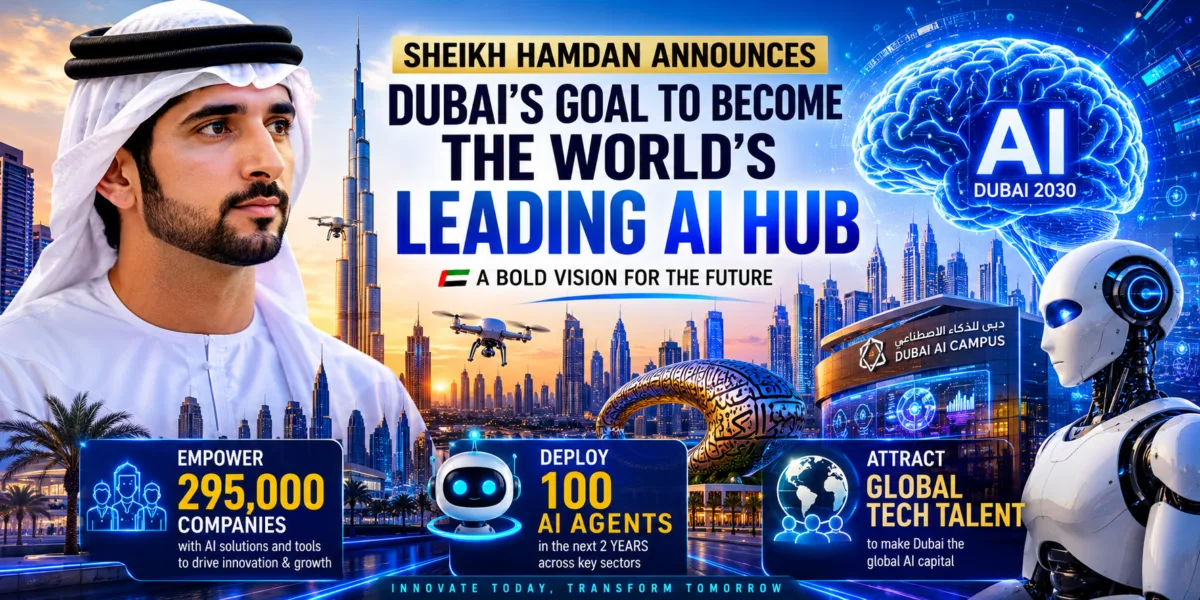
The centrepiece of the plan is the Agentic AI Transformation Programme, which according to Emirates 247’s full report on the committee meeting, aims to empower 295,000 companies across Dubai with artificial intelligence tools and capabilities. That is not a small or symbolic number. Dubai’s entire registered business community is being targeted for AI integration.
Sheikh Hamdan specifically highlighted that the next phase of AI development requires moving beyond traditional AI tools toward what the industry calls agentic AI. This refers to AI systems that do not simply answer questions or generate content, but that can actually execute tasks, make decisions within set parameters, and manage operations with a level of autonomy that traditional software cannot match. The practical applications range from automated customer service and supply chain management to complex financial modelling and medical diagnostic support.
100 Specialised AI Agents in Two Years
The programme commits to developing and deploying 100 specialised AI assistants across Dubai’s private sector within the next two years. Each of these agents will be tailored to specific industries and business functions, meaning a logistics company’s AI agent will look very different from one deployed in a healthcare setting or a financial services firm. The goal is not generic AI tools but purpose-built solutions designed for the specific needs of Dubai’s business ecosystem.
50 New Agentic AI Companies
The plan also includes support for establishing 50 new companies specifically focused on agentic AI development. This is the supply side of the equation. Rather than simply importing AI solutions built elsewhere, Dubai wants to become a place where AI companies are founded, funded, and grown into global players. Combined with the demand side target of 295,000 companies adopting AI, this creates the conditions for a genuine local AI economy rather than just consumption of foreign technology.
What Is Agentic AI and Why Is Dubai Betting on It
The term agentic AI has been gaining significant attention in the technology industry over the past year, and Dubai’s focus on it specifically deserves some explanation for anyone who is not immersed in the technical side of this conversation.
Traditional AI tools, including the chatbots and content generators that most people have used, operate in a reactive mode. You give them a prompt, they respond. The interaction ends there. Agentic AI operates differently. These systems can set their own sub-goals, take sequences of actions across multiple platforms and data sources, evaluate the results of those actions, adjust their approach, and continue working toward a longer-term objective with minimal human input at each step.
Think of the difference between asking someone a question and getting an answer, versus giving someone a project and having them come back with the completed work. That is roughly the shift from traditional AI to agentic AI. For businesses, the implications are enormous. Tasks that currently require teams of people to coordinate across multiple systems could be handled by AI agents working autonomously. The efficiency and cost implications could reshape entire industries.
Why This Shift Is Happening Now
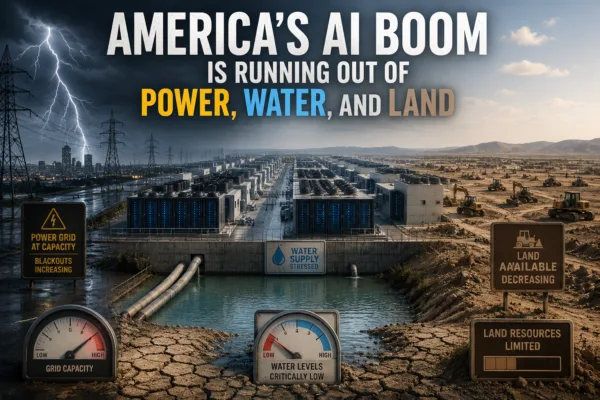
The technology to build genuinely useful agentic AI has only matured in the past 18 to 24 months. The large language models that power systems like ChatGPT and Google’s Gemini have become capable enough to serve as the reasoning engine inside more complex agentic systems, while improvements in tool integration allow these AI systems to actually connect to real-world data and services rather than just generating text. For context on the broader AI infrastructure story that is making all of this possible, see our detailed look at how America’s AI boom is being reshaped by power and infrastructure constraints. Dubai’s bet on agentic AI is essentially a bet that this technology wave is about to accelerate, and that the city that builds the right ecosystem now will capture enormous economic value from the companies and talent that follow.
The Dubai AI Campus: A Physical Home for the AI Economy
One of the most concrete pieces of infrastructure underpinning this ambition is the Dubai AI Campus, which Sheikh Hamdan reviewed during the June 11 committee meeting. The campus currently hosts more than 400 specialised technology companies and has trained over 1,500 participants through its integrated AI Academy.
The concept of an AI campus is significant. Rather than spreading AI development thinly across the city, Dubai is concentrating it in a dedicated space where companies, researchers, and investors can operate in proximity to each other. This kind of geographic clustering has been one of the key factors behind the success of Silicon Valley, where the density of talent, capital, and companies in a small area creates a compounding effect that is very difficult to replicate anywhere else.
Dubai’s version of this model is younger and smaller than Silicon Valley’s, but the fundamentals are sound. The AI Campus gives companies a physical address and an institutional identity as part of a recognised innovation community. The Academy gives the ecosystem a talent pipeline. The combination of these two elements is what allows a technology cluster to grow organically rather than depending entirely on government support.
The Dubai Global Talent Network: Attracting the World’s Best
One of the new initiatives approved during the June 11 meeting was the Dubai Global Talent Network, a platform designed to connect global technology talent with opportunities in Dubai, whether they are currently based in the emirate or have previously lived and worked there.
The logic behind this initiative is straightforward. AI development is fundamentally a talent competition. The cities and countries that attract the best AI researchers, engineers, and entrepreneurs will build the most capable AI ecosystems. Dubai already has significant advantages in this regard: world-class infrastructure, a tax environment that is highly attractive for high earners, a central geographic position between Europe and Asia, and a quality of life that appeals to internationally mobile professionals.
The Global Talent Network is designed to formalise and amplify those natural advantages by creating a dedicated platform where Dubai can maintain relationships with talented people who have a connection to the emirate, even if they are not currently living there. The networking and mentoring functions built into the platform give it practical utility beyond just a directory of names.
Smart Surveillance and the Digital Twin System for Dubai Police
Among the initiatives approved by Sheikh Hamdan was a project that gives a concrete example of how agentic AI will be applied in Dubai’s government operations. The Digital Twin System for Dubai Police uses advanced digital technologies to create an integrated virtual model of the city’s surveillance infrastructure, allowing for smarter monitoring, real-time data analysis, and improved field response coordination.
The pilot phase covers 150 cameras across Dubai. In practical terms, this means AI systems that do not just record footage but actively analyse it, flag relevant events, correlate data across multiple locations, and support decision-making by human operators. The system exemplifies the shift from passive data collection to active AI-assisted operations that underpins the broader agentic AI strategy.
Amazon Partnership and the SME Digital Trade Initiative
One of the most tangible signs that Dubai’s digital economy strategy is already producing results is the SME digital trade support initiative run in partnership with Amazon. As of May 2026, the programme had grown to support over 105,000 companies, more than three times its original scale, and had already exceeded its full-year target of 100,000 companies with several months still remaining in 2026.
This kind of public-private partnership between a government and one of the world’s largest technology companies is exactly the model Dubai is trying to scale across the economy. Amazon brings the platform, the logistics infrastructure, and the global market access. Dubai provides the regulatory environment, the geographic advantages, and the pool of businesses eager to expand their digital reach. Both sides benefit, and the result is measurable economic growth rather than just strategic positioning.
The ICPC World Finals: Dubai as a Global Tech Talent Destination
On the talent side of the equation, Sheikh Hamdan approved Dubai as the host city for the 50th edition of the International Collegiate Programming Contest World Finals, to be held from November 16 to 20, 2026. The ICPC is the world’s largest and most prestigious student programming competition, bringing together 140 teams from more than 70 countries. It is the event where the next generation of elite software engineers demonstrates what they can do on a global stage.
Hosting the ICPC Finals in Dubai does several things at once. It puts Dubai in front of tens of thousands of the world’s most talented young technology professionals at the moment they are deciding where to build their careers. It signals that Dubai is a city that takes programming and computer science seriously enough to host the sport’s equivalent of a World Championship. And it creates connections between Dubai’s technology ecosystem and students and universities from 70 countries that would be extremely difficult and expensive to build any other way.
How Dubai Compares to Other AI Hubs: The Competitive Landscape
Dubai’s ambition to become the world’s leading AI hub puts it in direct competition with some very established players. Silicon Valley remains the undisputed centre of global AI development, home to Google, Meta, Apple, OpenAI, Anthropic, and hundreds of smaller AI companies. China’s ecosystem is growing rapidly, particularly in applied AI for manufacturing, logistics, and surveillance. London and Paris are both making significant investments in positioning Europe as a counterweight to American and Chinese AI dominance.
What Dubai offers that these established hubs cannot is a combination of regulatory agility, zero personal income tax, a young and internationally diverse population, and a government that can move from policy announcement to implementation faster than most democratic governments are capable of. The regulatory environment for AI in Dubai is being specifically designed to attract companies that find US or European regulatory frameworks too slow or uncertain. For the broader story of how investment capital is flowing into AI globally, see our piece on the SpaceX IPO and what it tells us about the AI investment landscape in 2026.
The honest assessment is that Dubai is unlikely to overtake Silicon Valley in absolute terms in the near future. But the more interesting question is whether it can become the dominant AI hub in the Middle East and South Asia region, serving as the bridge between the technology supply in the West and the enormous market demand across a region of several billion people. That goal is far more achievable, and the plan announced this week is clearly calibrated toward it.
The Ignyte Platform and Dubai Founders HQ
Two more pieces of the ecosystem are worth noting. The Ignyte platform, which provides integrated services for entrepreneurs and startups including over 3,000 specialised mentoring sessions, now has more than 36,000 users. Dubai Founders HQ attracted over 1,100 members and 500 startups within just nine months of its launch, with companies in its portfolio raising over 200 million AED in funding.
These platforms are the connective tissue of an innovation ecosystem. Individual companies and ideas need places to form, advisors to guide them, and investors to fund them. The fact that both of these platforms are growing rapidly suggests that the broader AI and technology ecosystem in Dubai has real momentum behind it, not just government announcements.
What This Means for American Companies and Investors
For American technology companies, Dubai’s AI ambitions represent both an opportunity and a competitive consideration. On the opportunity side, Dubai is actively seeking partnerships with global technology leaders. The committee meeting specifically highlighted the AI Infrastructure Empowerment Platform, which has already been adopted by 27 government entities and is designed to accelerate AI integration across public services. American companies with proven AI solutions have a genuine pathway to significant government contracts in a wealthy, stable market.
On the competitive side, a well-funded AI hub in Dubai could attract talent and capital that might otherwise flow to American technology companies. If Dubai successfully creates the conditions for AI companies to grow there rather than in the US, that changes the geography of the global technology industry in ways that American policymakers and investors will need to factor into their thinking.
Frequently Asked Questions (FAQs)
Q1. What did Sheikh Hamdan announce about Dubai’s AI plans on June 11, 2026?
Sheikh Hamdan announced an executive plan for an Agentic AI Transformation Programme aimed at empowering 295,000 companies in Dubai, developing and deploying 100 specialised AI agents within two years, and supporting the establishment of 50 new agentic AI companies. He also approved several new digital economy initiatives including the Dubai Global Talent Network and the Digital Twin System for Dubai Police.
Q2. What is agentic AI and why is Dubai focusing on it specifically?
Agentic AI refers to AI systems that can execute tasks, make decisions, and manage operations with a significant degree of autonomy, rather than simply responding to individual prompts. Dubai is focusing on agentic AI because it represents the next major wave of AI capability, with the potential to transform business operations across virtually every industry by automating complex, multi-step processes.
Q3. How many companies does Dubai plan to empower with AI?
Dubai’s Agentic AI Transformation Programme targets 295,000 companies across the emirate. This represents a comprehensive approach to AI adoption across Dubai’s entire business community, not just large corporations or technology companies.
Q4. What is the Dubai AI Campus?
The Dubai AI Campus is a dedicated technology hub that currently houses more than 400 specialised companies and has trained over 1,500 participants through its integrated AI Academy. It is designed to create the kind of dense technology cluster that has driven innovation in places like Silicon Valley, bringing together companies, researchers, and investors in a shared physical and institutional space.
Q5. When is the ICPC World Finals being held in Dubai?
The 50th edition of the International Collegiate Programming Contest World Finals, the world’s largest student programming competition, will be held in Dubai from November 16 to 20, 2026. The event features 140 teams from more than 70 countries and is one of the most prestigious programming competitions in the world.
Q6. How is Dubai’s AI strategy different from what the US and China are doing?
Dubai’s approach emphasises regulatory agility, private sector empowerment, and international talent attraction in ways that are distinct from both the US and Chinese models. While the US relies primarily on private sector-led innovation and China on state-directed industrial policy, Dubai is pursuing a hybrid model that combines active government direction with commercial incentives specifically designed to attract foreign companies and talent to operate within its ecosystem.
The announcement that Dubai is targeting the title of world’s leading AI hub might have seemed like a bold marketing claim a few years ago. In June 2026, with a concrete plan, measurable targets, real infrastructure, and functioning partnerships with global technology giants already in place, it reads differently. The city that built the world’s tallest building, the world’s largest airport, and one of the world’s most ambitious financial centres is now applying the same disciplined ambition to artificial intelligence. Whether Dubai becomes the world’s leading AI hub is a question that will take years to answer. What is clear right now is that the plan is serious, the investment is real, and the rest of the world should be paying attention. For more technology news and business stories shaping the global economy, keep reading Weblogs4u.