
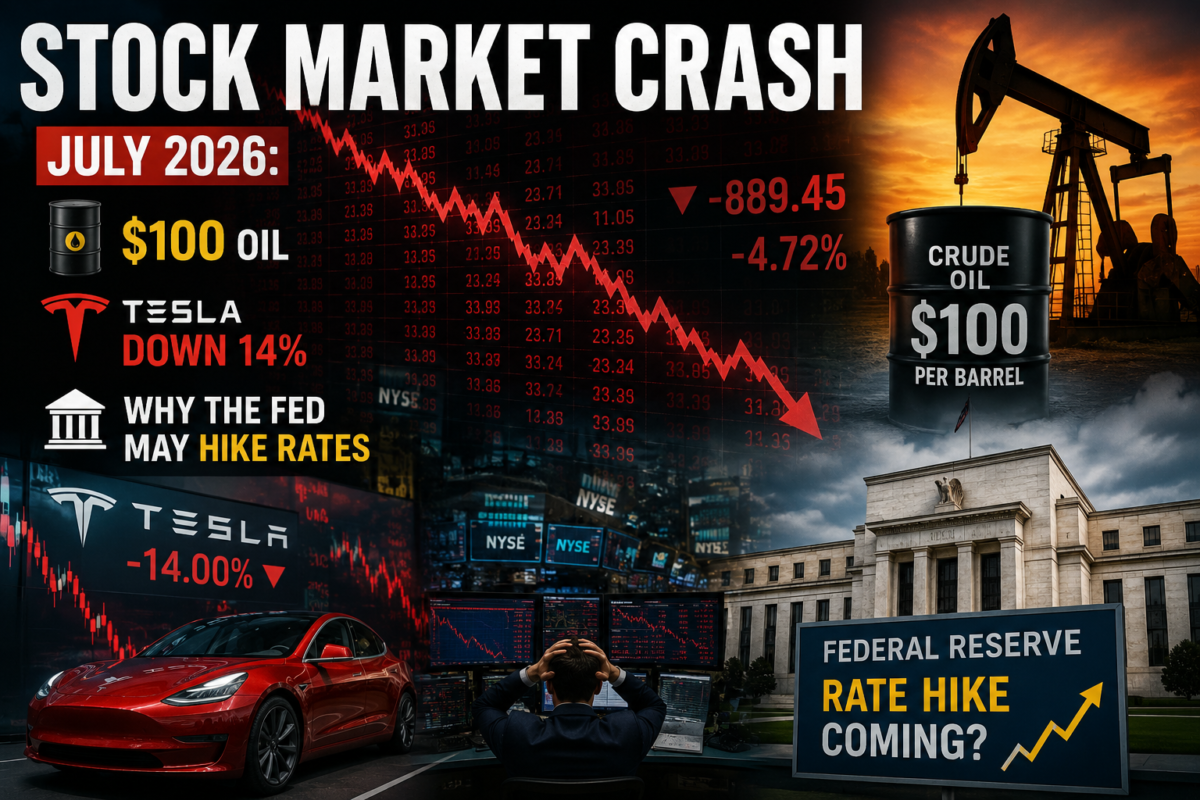


American investors had a rough week and Thursday July 23 was the worst of it. The stock market crash July 2026 has been building for days, but Thursday crystallised just how many things can go wrong at the same time: oil surged toward $100 a barrel as Houthi militants attacked Saudi oil tankers in the Red Sea, Tesla dropped 14 percent after a disappointing earnings report, Alphabet fell 7 percent on concerns about runaway AI spending, and the odds of a Federal Reserve interest rate hike, which almost nobody was pricing in a month ago, suddenly surged. The Dow dropped over 500 points, the S&P 500 lost 1.21 percent, and the Nasdaq fell 2.15 percent. Here is exactly what happened, why it matters, and what investors and everyday Americans should understand about what comes next.
The Numbers: How Bad Was Thursday
According to CNBC’s live market coverage for July 23, 2026, the Dow Jones Industrial Average lost 506.93 points, or 0.97 percent, closing at 51,711.65. The S&P 500 dropped 1.21 percent to 7,408.30. The Nasdaq Composite, which carries the heaviest concentration of technology stocks, declined 2.15 percent to close at 25,137.69.
For context, these single-day drops are meaningful but not catastrophic in isolation. What makes them significant is the combination of factors driving them simultaneously, and the question they raise about whether the market is entering a more sustained period of volatility rather than experiencing an ordinary pullback.
Trigger One: Tesla Down 14 Percent After Earnings
Tesla’s earnings report was the most dramatic individual story of the day. The electric vehicle company reported quarterly results that fell short of what analysts had been expecting, and the market responded with a sharp, unforgiving reaction. A 14 percent single-day drop in a company of Tesla’s size and visibility sends a shockwave through investor sentiment that extends well beyond the stock itself.
What the Tesla Numbers Actually Said
Tesla has been navigating a difficult environment for electric vehicle sales throughout 2026, with increased competition from Chinese manufacturers, ongoing pressure on pricing margins as the company discounts vehicles to maintain sales volume, and slower-than-expected growth in its energy storage and services businesses. The quarterly results, while not catastrophically bad, were enough to disappoint a market that had priced in a recovery that did not fully materialise.
The 14 percent drop reflects not just one bad quarter but accumulated investor frustration with a gap between Tesla’s stock valuation, which has always reflected enormous future growth expectations, and its current operational results. When a company valued on the promise of the future delivers results that look ordinary in the present, the math gets painful very quickly.
Trigger Two: Alphabet Down 7 Percent on AI Spending Concerns
Alphabet, Google’s parent company, also had a rough Thursday, falling 7 percent after its earnings report fuelled fresh concerns about the scale of its artificial intelligence spending. This is part of a broader story developing across major technology companies in mid-2026. As CNBC reported on Moody’s analysis of the situation, the credit rating agency released a warning this week that the “unprecedented” AI spending commitments of Amazon, Meta, Alphabet, and other large technology companies threatens their credit quality. Moody’s flagged that the scale of capital expenditure being directed toward AI infrastructure is substantial enough to put meaningful pressure on cash flows and balance sheets, even for companies as profitable as these.
Alphabet’s specific situation reflects a tension that investors are increasingly uncomfortable with: the company is spending tens of billions of dollars building AI infrastructure and capabilities whose revenue payoff remains uncertain in timing and scale. That uncertainty, combined with a market already on edge from oil prices and geopolitical risk, was enough to send the stock sharply lower.
The Broader AI Spending Debate
The Alphabet result is part of a wider reckoning happening in technology markets right now. The AI infrastructure boom, which we examined in detail in our earlier piece on how America’s AI buildout is straining power grids and budgets, has produced enormous capital expenditure commitments from every major technology company. As long as investors believed the returns would justify the spending, the stocks held up. Now, with quarterly results coming in and the returns timeline remaining unclear, patience is thinning. CNBC noted that the “sell chips, buy software” trade reappeared this week, reflecting a market rotation away from the infrastructure play toward software companies that can benefit from AI without carrying the same capital cost burden.
Trigger Three: Oil Surges Toward $100 as Middle East Tensions Escalate
The third and in some ways most consequential factor in Thursday’s selloff was oil. Yemen’s Tehran-backed Houthi militant group claimed attacks on two Saudi Arabian tankers in the Red Sea, according to CNBC’s coverage of the commodity market reaction, sending oil prices sharply higher and raising fears of a broader escalation of conflict in the Middle East that could disrupt global energy supplies.
The Strait of Hormuz and surrounding waterways handle an enormous portion of the world’s daily oil shipments. Any credible threat to the safety of tanker transit through these routes immediately pushes oil prices upward as traders price in potential supply disruption. When oil approaches or crosses the $100 per barrel mark, the consequences ripple far beyond the energy sector.
Why $100 Oil Changes the Entire Economic Conversation
At $100 per barrel, oil prices affect everything Americans pay for, not just gasoline. Virtually every product manufactured and shipped in the global economy has energy embedded in its cost, from the plastic packaging around consumer goods to the fuel burned by the trucks that deliver them. When energy prices rise sharply and remain elevated, inflation follows across a broad range of goods, not just at the fuel pump.
This is precisely what has the Federal Reserve’s attention right now. As Sameer Samana, senior global market strategist at Wells Fargo Investment Institute, explained in commentary covered by CNBC, “Oil and gasoline prices will both weaken consumers and the economy while also complicating life for central banks in their fight against inflation. They will need to think about raising rates more and faster than if things were calming in the Middle East.”
The Fed Rate Hike Odds Are Now Real
Perhaps the most significant market development of this week is not the single-day stock drop but the shift in what investors expect the Federal Reserve to do next. As CNBC’s finance reporting noted on July 23, the odds of a Federal Reserve rate hike have surged as oil prices moved higher. This is a dramatic shift from the prevailing consensus even a few weeks ago, when most economists and market participants expected the Fed to hold rates steady through the rest of 2026 and potentially begin cutting in 2027.
The logic is straightforward: if oil prices stay elevated near $100 or above, inflation, which has already been running above the Fed’s 2 percent target, gets pushed higher. A Fed that is already dealing with above-target inflation and then watches energy prices add fuel to the fire has fewer options to stay on hold. Hiking rates becomes a more credible response, even if it risks slowing economic growth at the same time.
What This Means for Kevin Warsh’s Next Meeting
Fed Chair Kevin Warsh, who held his first meeting without raising rates in June, as we covered in our detailed breakdown of that June 17 decision, now faces a significantly more complicated policy environment heading into the next FOMC meeting. At that point he will have to weigh an oil-driven inflation resurgence against a stock market already showing stress and an economy where consumer spending remains the primary growth driver. The pressure on him to demonstrate Fed independence while navigating a set of deteriorating conditions is real and immediate.
CNBC noted this week that some analysts are now explicitly making the case that the Federal Reserve should hike rates at its next meeting given the inflation risk from oil. Whether Warsh and the committee agree is one of the most consequential questions facing American financial markets right now.
The Tariff Wildcard: Trump vs the EU
Adding a fourth layer of pressure to markets this week, President Trump threatened the European Union with what he called a “substantial TARIFF” for “ROBBING” US technology giants, according to CNBC’s reporting on the developing trade situation. This came alongside a separate report that Europe fined Google $1 billion for what regulators described as harming rivals under sweeping online competition law.
The tariff threat adds to an already complicated trade backdrop. As NPR’s business coverage noted, Trump has imposed sweeping new tariffs with the stated goal of benefiting US workers, but there is mounting evidence that these measures are raising costs for American households and businesses that depend on imported goods.
The Economy Behind the Headlines
Despite the market turmoil, the underlying American economy presents a genuinely complicated picture. As CNN Business reported, wealthy Americans are keeping the economy afloat through continued high spending, even as middle and lower-income households increasingly feel squeezed. The same reporting noted that more Amazon and gig workers are turning to government assistance programs like SNAP and Medicaid to supplement inadequate incomes, a data point that tells a very different story about the economy than the stock market indices do.
A separate NPR report this week found that about 24 percent of US employees are staying in jobs they do not want specifically to keep their employer-sponsored health insurance, a phenomenon known as job lock. As NPR’s business team reported, this figure has risen significantly since 2021 and represents a real constraint on labour market dynamism, with people unable to move toward better opportunities or start businesses because the cost of individual health insurance is prohibitive without employer coverage.
What the Week Ahead Looks Like
Next week brings more megacap technology earnings reports, another Federal Reserve meeting, and the ongoing pressure from oil prices and Middle East uncertainty. The combination is exactly what market strategists describe as a market on edge, where each piece of news carries outsized potential to move prices in either direction.
For investors, the practical question is whether this week’s selloff represents a healthy correction within a larger uptrend, a normal period of volatility after an extended rally, or the beginning of something more sustained driven by a genuine shift in the inflation and interest rate outlook. The honest answer is that nobody knows with certainty, and anyone claiming otherwise is overconfident.
What is clear is that the easy money environment of low rates and stable energy prices that supported the stock market rally of the past two years is under genuine pressure from multiple directions simultaneously. Oil prices, geopolitical risk, AI spending concerns, tariff uncertainty, and a potentially more hawkish Federal Reserve are not individually catastrophic, but together they represent a more challenging investing environment than Americans have had to navigate for some time.
What This Means for Everyday Americans
Gasoline Prices
The most direct impact of rising oil prices on everyday Americans is at the gas pump. If crude oil stays near $100 per barrel, expect gasoline prices to rise in the weeks ahead, with the exact impact varying by region and by how quickly refiners and retailers pass through higher input costs.
Grocery and Consumer Prices
Higher energy costs eventually flow through to the price of almost everything manufactured and shipped. This happens with a lag of several weeks to months, but sustained $100 oil would put additional upward pressure on grocery prices, which have already been running significantly above pre-pandemic levels.
Mortgage and Borrowing Rates
If the Federal Reserve does hike rates in response to oil-driven inflation, mortgage rates, credit card rates, and the cost of business loans would all move higher. For homebuyers already dealing with elevated home prices and interest rates, a rate hike would be unwelcome news.
Your 401k and Investment Accounts
Market volatility directly affects the balances of retirement accounts and investment portfolios. For long-term investors with years or decades before retirement, short-term drops are generally not a reason to make dramatic changes to a diversified investment strategy. For those close to retirement who are planning to begin drawing down accounts, a period of sustained volatility is worth discussing with a financial advisor.
Frequently Asked Questions (FAQs)
Q1. How much did the stock market drop on July 23 2026?
On July 23, 2026, the Dow Jones Industrial Average fell 506.93 points, or 0.97 percent, closing at 51,711.65. The S&P 500 dropped 1.21 percent to 7,408.30. The Nasdaq Composite declined 2.15 percent to 25,137.69, weighed down by large drops in major technology stocks including Tesla and Alphabet.
Q2. Why did Tesla stock drop 14 percent?
Tesla fell 14 percent on July 23 after releasing quarterly earnings results that disappointed investors. The results reflected ongoing pressure on the company’s profit margins from vehicle price cuts, increased competition particularly from Chinese electric vehicle manufacturers, and slower than expected growth in its energy and services businesses.
Q3. Why is oil approaching $100 and what does it mean?
Oil prices surged after Yemen’s Houthi militant group, backed by Iran, claimed attacks on two Saudi Arabian oil tankers in the Red Sea, raising fears of broader conflict disruption to Middle East oil shipping routes. At $100 per barrel, oil raises costs across the entire economy, from transportation to manufacturing, and puts upward pressure on inflation, which complicates the Federal Reserve’s interest rate decisions.
Q4. Could the Federal Reserve raise interest rates in 2026?
The odds of a Federal Reserve rate hike have increased significantly this week as oil prices surged. While most economists were not expecting a rate hike a month ago, the combination of above-target inflation and rising energy prices has made a hike a more credible possibility heading into the next FOMC meeting. Fed Chair Kevin Warsh’s response to deteriorating economic conditions will be one of the most closely watched financial stories of the coming weeks.
Q5. What happened to Alphabet stock and why?
Alphabet, Google’s parent company, fell 7 percent after earnings results raised investor concerns about the scale and return timeline of its artificial intelligence spending. Moody’s separately issued a warning this week that the unprecedented AI capital expenditure commitments of Alphabet, Amazon, Meta, and other large technology companies threatens their credit quality, adding to investor unease.
Q6. Should I change my investments because of this market drop?
For long-term investors with a diversified portfolio and years or decades before needing to access their money, single-week market drops are generally not a reason to make dramatic changes to an investment strategy. For those close to retirement or who need the money soon, the current environment warrants a conversation with a qualified financial advisor who can assess your specific situation. This article is informational only and does not constitute financial advice.
The stock market crash July 2026 brings together some of the most consequential economic forces of the current moment: geopolitical instability driving energy prices, technology companies facing harder questions about their AI spending, a Federal Reserve weighing an increasingly uncomfortable set of options, and everyday Americans navigating the cost of living pressures that never fully went away. Whether this week represents a turning point or a temporary bout of turbulence depends on how oil prices evolve, how the Fed responds, and whether the technology sector earnings picture stabilises. What is certain is that the relatively smooth market conditions of the past year are giving way to something more complicated and more consequential. For more business and finance news and analysis of the trends shaping your money in 2026, keep reading Weblogs4u.