
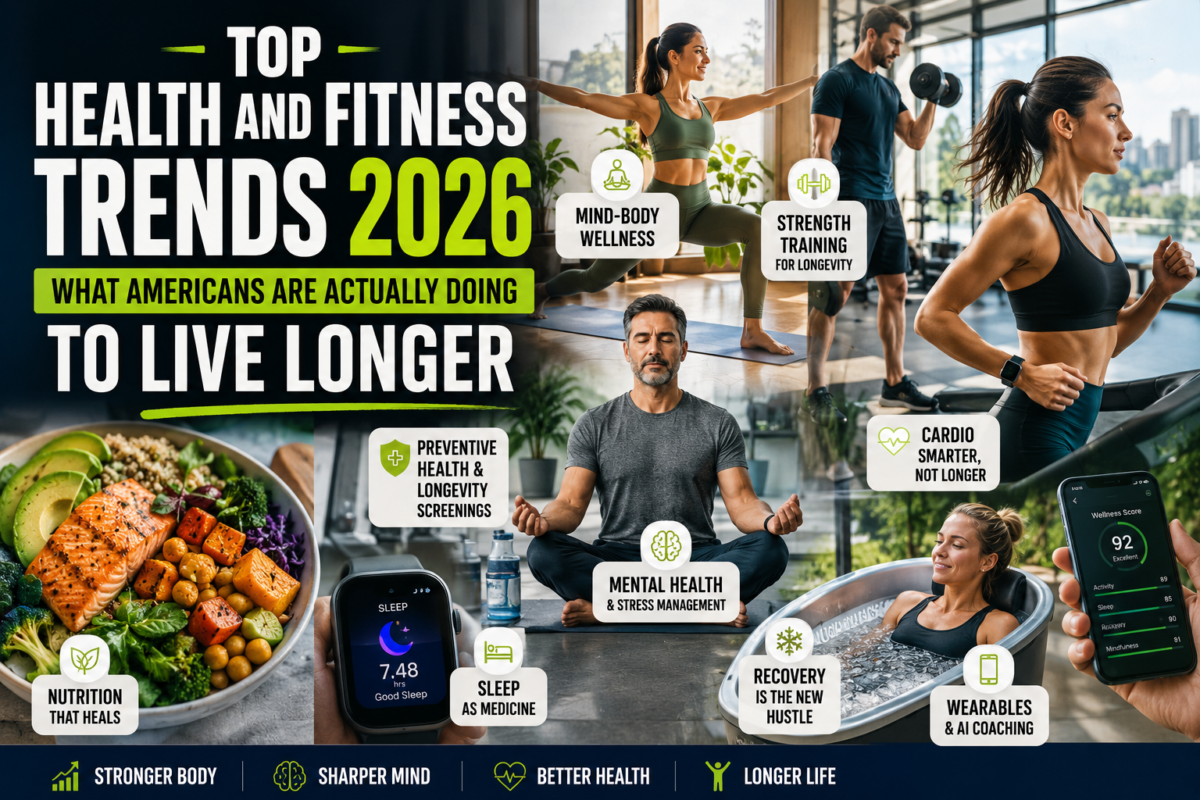


Something real is shifting in the way Americans think about their bodies and their health. The health and fitness trends 2026 has produced are not built around aesthetics, extreme diets, or punishing workout schedules. They are built around a simpler, more honest question: how do I stay capable, sharp, and independent for as long as possible? From the extraordinary viral rise of Japanese walking to the explosion of wearable health tracking, from resistance training being reframed as fall prevention to sleep finally being treated as the serious health variable it always was, 2026 marks a year when the fitness conversation grew up. Here is what is actually trending, what the research says about each one, and which of these shifts are worth paying attention to.
The Biggest Shift: Americans Are Training for Longevity, Not Looks
The most significant finding in the National Academy of Sports Medicine’s 2026 industry survey of 625 fitness professionals is the one that explains almost everything else on this list. As NASM’s full trends report documents, longevity and healthy aging have overtaken traditional physique goals as the fastest-growing client motivations in the fitness industry. Americans are no longer primarily working out to look better. They are working out to live longer and to stay functional while doing it.
A separate survey commissioned by Orangetheory Fitness confirms this at the consumer level. According to PureWow’s 2026 fitness trends coverage, 60 percent of Americans now cite longevity and healthy aging as their top fitness motivator. That number represents a genuine cultural shift, not a passing fad. When the majority of Americans change what they are exercising for, every downstream trend in nutrition, workout design, supplement choices, and fitness technology changes with it.
As Glimpse’s 40 top health and wellness trends analysis for 2026 puts it, the tone has shifted from anti-aging language to longevity, resilience, and function. It is not about youth. It is about staying capable.
1. Japanese Walking: The Year’s Most Explosive Fitness Trend
No fitness trend in 2026 has grown faster than Japanese walking. According to data highlighted in PureWow’s fitness trends analysis, PureGym’s annual fitness report found a staggering 2,986 percent surge in interest in Japanese walking, making it the single fastest-growing fitness trend of the year.
What Japanese Walking Actually Is
Japanese walking, also known as interval walking training, was developed by researchers at Shinshu University in Japan. The method alternates between three minutes of brisk, high-intensity walking and three minutes of slow, comfortable walking, repeated over 30 minutes. The pace during the intense intervals should feel genuinely challenging, around 70 percent of your maximum aerobic capacity, while the slow intervals allow recovery.
The research behind this method is genuinely strong. Studies from the Shinshu University team found that participants who practiced interval walking training five times a week for five months showed significantly greater improvements in aerobic fitness and muscle strength compared to those who walked continuously at a moderate pace for the same duration. Improvements in blood pressure, blood sugar regulation, and quality of life measures were also documented.
TikTok is partly responsible for the current surge in popularity, but the underlying science predates the viral attention by nearly two decades. This is not a trend that will disappear because it lacks evidence. The research is solid, the method is free, and it requires nothing beyond a pair of comfortable shoes.
Why It Appeals to So Many Americans Right Now
The timing of Japanese walking’s popularity makes sense when you understand the broader longevity shift happening in fitness. It is not a high-impact workout that risks injury. It does not require gym membership or equipment. It fits into a lunch break. Older Americans can do it. People recovering from injuries can adapt it. And the research shows real, measurable cardiovascular and metabolic benefits, which is exactly what people focused on healthspan rather than appearance want to see.
2. Wearable Technology: The Number One Trend According to 2,000 Experts
For the second consecutive year, wearable technology has claimed the top spot in the American College of Sports Medicine’s annual Worldwide Fitness Trends report. As the ACSM’s official 2026 trends announcement confirms, the ranking is based on a survey of 2,000 clinicians, researchers, and exercise professionals. The top five trends behind wearables are fitness programs for older adults, exercise for weight management, mobile exercise apps, and balance, flow, and core strength.
The Oura Ring and WHOOP band have moved wearable health tracking from the gym-obsessed minority into the mainstream. These devices track not just steps and heart rate but sleep stages, heart rate variability, recovery scores, and readiness metrics that tell you whether your body is prepared for intense training or needs a lighter day. For people focused on longevity rather than appearance, this kind of data is enormously compelling.
Sleep Tracking: From Afterthought to Primary Health Metric
One of the most significant developments inside the wearable technology trend is the rise of sleep tracking as a primary health metric. As Glimpse’s wellness trends data shows, sleep optimization has become one of the most mainstream health upgrades of 2026. People are now connecting the dots between poor sleep and their everyday performance in ways they simply were not doing five years ago.
Wearables turned rest into a measurable metric rather than a mystery. Once people can see their sleep data, the patterns become impossible to ignore. That evening glass of wine appears in the heart rate variability numbers the next morning. The 3pm espresso shows up in how long it takes to fall asleep. The connection between behavior and sleep quality, made visible through data, has changed how millions of Americans manage their evenings.
If you want to understand how to build better sleep habits alongside your fitness routine, our earlier piece on morning habits that actually transform your health covers the daily practices that science links most strongly to better sleep quality and sustained energy.
3. Resistance Training for Longevity: Not Just for Bodybuilders Anymore
Resistance training has been reframed this year, and the reframing matters. As Glimpse’s analysis puts it directly, in fitness trends, resistance training is being reframed as fall prevention. That language signals something important: the primary audience being targeted by this trend in 2026 is not young people trying to build muscle. It is adults over 40, 50, and 60 who are trying to preserve the physical capability that lets them live independently and actively as they age.
The science behind this is well-established but underappreciated in public health messaging. After age 30, adults lose roughly 3 to 5 percent of their muscle mass per decade in a process called sarcopenia. After age 60, that rate accelerates. Muscle mass is directly linked to metabolic health, insulin sensitivity, bone density, balance, and the ability to perform the activities of daily life without assistance. Resistance training is the most effective intervention available to slow and partially reverse this process.
Functional Fitness: Training for Real Life Movements
Within the broader resistance training trend, functional fitness has emerged as the specific approach getting the most attention. As Glimpse’s top fitness trends breakdown notes, unlike traditional weightlifting that isolates individual muscles, functional fitness trains movement patterns using bodyweight, kettlebells, resistance bands, and compound lifts that mirror real-world physical demands.
Carrying groceries, climbing stairs, getting up from the floor, reaching overhead, balancing on one leg while putting on a shoe. These are the movements that matter for actual quality of life, and functional fitness programs are explicitly designed around making them easier and safer. The aging consumer demographic is driving this shift, but younger audiences focused on injury prevention and athletic performance are also drawn to the approach.
4. Hybrid Training: The End of Single-Style Workouts
The all-or-nothing workout era is over. Glimpse’s fitness trends analysis identifies hybrid training as one of the most notable shifts in how Americans approach exercise in 2026. The concept is straightforward: rather than committing exclusively to one type of exercise, more people are combining strength training, cardio, and mobility work in integrated programs.
The practical examples are numerous. Someone might lift weights three days a week, cycle on two days, and do yoga on a sixth day. Another person might follow a powerlifting program while also training for a 5K. A third might blend HIIT sessions with Pilates and long weekend hikes. The common thread is deliberate variety and balance rather than specialisation.
The appeal is both practical and physiological. From a practical standpoint, hybrid training reduces workout boredom and the psychological pressure of following a rigid single-discipline program. From a physiological standpoint, combining different training modalities tends to produce more complete fitness outcomes, better cardiovascular health alongside strength, better mobility alongside endurance, that a single-focus approach tends to leave gaps in.
5. Zone 2 Cardio: The Training Method Elite Athletes Swear By
Zone 2 cardio has moved from elite sports science into mainstream fitness conversations in 2026, and the shift is driven largely by the longevity angle that is reshaping everything in this space. Zone 2 refers to a specific intensity level of aerobic exercise, roughly 60 to 70 percent of your maximum heart rate, where you are working but could still maintain a conversation without gasping.
At this intensity, your body primarily uses fat as fuel and the mitochondria, the energy-producing structures inside your cells, are trained most efficiently. Endurance athletes have trained in Zone 2 for decades precisely because it builds the aerobic foundation that supports performance at higher intensities. The longevity research community has become interested in Zone 2 because mitochondrial health is increasingly understood as central to metabolic function, cellular repair, and biological aging.
For regular Americans, Zone 2 training means brisk walking, easy cycling, light jogging, or swimming at a pace that feels sustainable for 45 to 60 minutes. It is lower impact than HIIT, easier to recover from, and can be done more frequently. For people focused on long-term health rather than peak athletic performance, it fits naturally alongside the Japanese walking approach and the broader longevity-first orientation of 2026 fitness culture.
6. Protein Timing and Anti-Inflammatory Nutrition
The nutrition side of the 2026 health picture is equally telling. As Glimpse’s wellness analysis highlights, interest in protein timing, anti-inflammatory foods, and cellular repair is rising in 2026, not as a diet, but as a strategy for healthspan.
Protein timing refers to paying attention to when you consume protein relative to exercise, particularly prioritising protein intake within a few hours of resistance training to support muscle protein synthesis. For older adults especially, research suggests that distributing protein intake evenly across meals throughout the day, rather than concentrating it at dinner, improves how effectively the body uses it for muscle maintenance and repair.
Creatine and Collagen: Mainstream Supplements in 2026
Two supplements have crossed into the mainstream this year in ways that would have surprised many people just a few years ago. As Glimpse’s wellness trends data shows, creatine and collagen are no longer just for bodybuilders or beauty routines. They are being taken for maintaining muscle mass and joint health into your 70s.
Creatine monohydrate has one of the strongest safety and efficacy profiles of any supplement in existence, with decades of research supporting its benefits for muscle performance, cognitive function, and increasingly, healthy aging. Collagen supplementation for joint health and connective tissue support has similarly moved from niche to mainstream, driven by the same aging demographic that is reorienting all of fitness around longevity.
7. Assisted Stretching: Professional Recovery Goes Mainstream
One of the more surprising entries in the 2026 fitness trends is the explosive growth of assisted stretching as a standalone service. As Glimpse’s fitness trends report identifies, assisted stretching has become one of the most notable healthcare trends within the fitness space, as more people prioritize recovery, injury prevention, and overall mobility. Boutique studios like StretchLab and LYMBR are opening across the US, catering to everyone from athletes to desk workers looking to counteract stiff posture and tight hips.
The concept is straightforward: a trained professional helps you stretch your muscles more deeply and safely than you can on your own, incorporating elements of massage and physical therapy. The sessions target specific tight or underused muscle groups and are particularly popular among people over 40, office workers dealing with posture problems, and athletes using it as part of a recovery protocol.
The growth of assisted stretching reflects the same underlying trend as everything else on this list. Recovery is being taken as seriously as training. Mobility is being treated as a fitness goal in its own right. And Americans are increasingly willing to invest in professional services that support long-term physical function rather than just workout performance.
8. Community-Driven Fitness: Run Clubs and Group Training
The social dimension of fitness has become a major trend driver in 2026. As NASM’s industry report notes, community-driven fitness is exploding because people are craving connection just as much as they are craving a good workout. Run clubs, small-group training, and creator-led programs feel more fun, social, and accessible than traditional one-on-one sessions.
Run clubs in particular have had a remarkable moment in the past two years. What began as a niche activity for serious runners has expanded into a genuinely social phenomenon, with clubs in cities across America attracting people who would never have described themselves as runners a few years ago. The combination of low barrier to entry, regular social contact, and a built-in accountability structure makes run clubs one of the more effective community fitness models available.
For people who have tried and failed to maintain solo gym routines, the community component is often the missing element. Showing up for other people is a different motivational driver than showing up for yourself, and for many Americans it is a more durable one.
What Is Losing Ground: Trends Falling Out of Favour
Not every fitness trend is gaining momentum in 2026. A few approaches that dominated recent years are noticeably losing traction.
Extreme HIIT culture, the ethos of more intensity always being better, is fading as the research on recovery, overtraining, and injury risk has become better understood by the general public. The shift toward Zone 2 cardio and hybrid training reflects a growing appreciation that sustainable moderate intensity often produces better long-term outcomes than the punishing all-out approach.
Crash dieting and severe calorie restriction are also losing ground to the protein-forward, anti-inflammatory nutrition approach. The language of deprivation is being replaced by the language of fueling and supporting cellular health, a framing that is both more accurate and more sustainable for most people.
And the single-metric obsession with weight as the primary measure of health progress is giving way to a more nuanced set of metrics: energy levels, strength benchmarks, sleep quality scores, cardiovascular fitness markers, and mobility assessments. This is a healthy shift, both literally and culturally.
Frequently Asked Questions (FAQs)
Q1. What is the number one fitness trend in the USA in 2026?
According to the American College of Sports Medicine’s annual survey of 2,000 clinicians and fitness professionals, wearable technology is the number one fitness trend in 2026. In terms of the fastest-growing consumer trend by search interest, Japanese walking saw a 2,986 percent surge in popularity, making it the single fastest-rising trend of the year. The overarching shift driving almost every trend is the move toward longevity and healthy aging as the primary fitness motivation, which NASM’s 2026 industry survey confirms has now overtaken aesthetic goals.
Q2. What is Japanese walking and why is it trending so strongly in 2026?
Japanese walking, also called interval walking training, alternates three minutes of brisk high-intensity walking with three minutes of slow comfortable walking, repeated over 30 minutes. It was developed by researchers at Shinshu University in Japan and has strong research backing for improving cardiovascular fitness, muscle strength, blood pressure, and blood sugar regulation. It is trending because it is free, low-impact, accessible to all ages, and fits naturally into the longevity-focused mindset dominating 2026 fitness culture. Search interest in the method surged nearly 3,000 percent this year.
Q3. Is resistance training really that important for healthy aging?
Yes, significantly so. After age 30, adults lose 3 to 5 percent of their muscle mass per decade, with the rate accelerating after 60. Muscle mass is directly connected to metabolic health, bone density, balance, insulin sensitivity, and the ability to perform daily physical activities independently. Resistance training is the most effective intervention available for slowing and partially reversing this process, which is why it has been reframed in 2026 as fall prevention and longevity medicine rather than a bodybuilding tool.
Q4. What is Zone 2 cardio and how is it different from regular cardio?
Zone 2 cardio means exercising at roughly 60 to 70 percent of your maximum heart rate, a pace where you are working but could still hold a conversation. At this intensity, your body primarily uses fat as fuel and your mitochondria are trained most efficiently. This is distinct from higher-intensity cardio where you are breathing too hard to speak comfortably. Zone 2 builds the aerobic foundation that supports long-term health, metabolic function, and endurance, and can be done more frequently than high-intensity workouts because recovery demand is lower.
Q5. What supplements are most popular in health and fitness in 2026?
Creatine monohydrate and collagen are the two supplements that have moved most decisively into the mainstream in 2026, driven by the longevity and healthy aging trend. Creatine has decades of research supporting its benefits for muscle performance, strength, and increasingly cognitive function. Collagen is popular for joint health and connective tissue support. Both are being taken by a much wider demographic than their traditional users, including older adults and people focused on long-term physical function rather than athletic performance.
Q6. How has fitness motivation in America changed in 2026?
The single biggest shift in 2026 is that 60 percent of Americans now cite longevity and healthy aging as their primary fitness motivation, overtaking traditional aesthetic goals like weight loss or building muscle. This change is reshaping everything downstream: what workouts people choose, what they eat, which supplements they take, how they think about sleep and recovery, and what metrics they use to measure progress. The fitness conversation has broadly shifted from how do I look to how do I function and for how long.
The health and fitness trends 2026 is producing are, taken together, one of the most encouraging shifts in how Americans relate to their own wellbeing in a long time. The move away from extreme aesthetics and punishing routines toward sustainable, science-backed practices oriented around living longer and functioning better is genuinely good news for public health. Japanese walking, Zone 2 cardio, resistance training for healthy aging, sleep optimization, hybrid training, and community fitness all share a common foundation: they are built to last, not to impress. If you want to put some of these ideas into practice right away, start with our guide to morning habits that actually transform your health and build from there. For more health and fitness coverage, the latest news, and everything shaping American life in 2026, keep reading Weblogs4u.