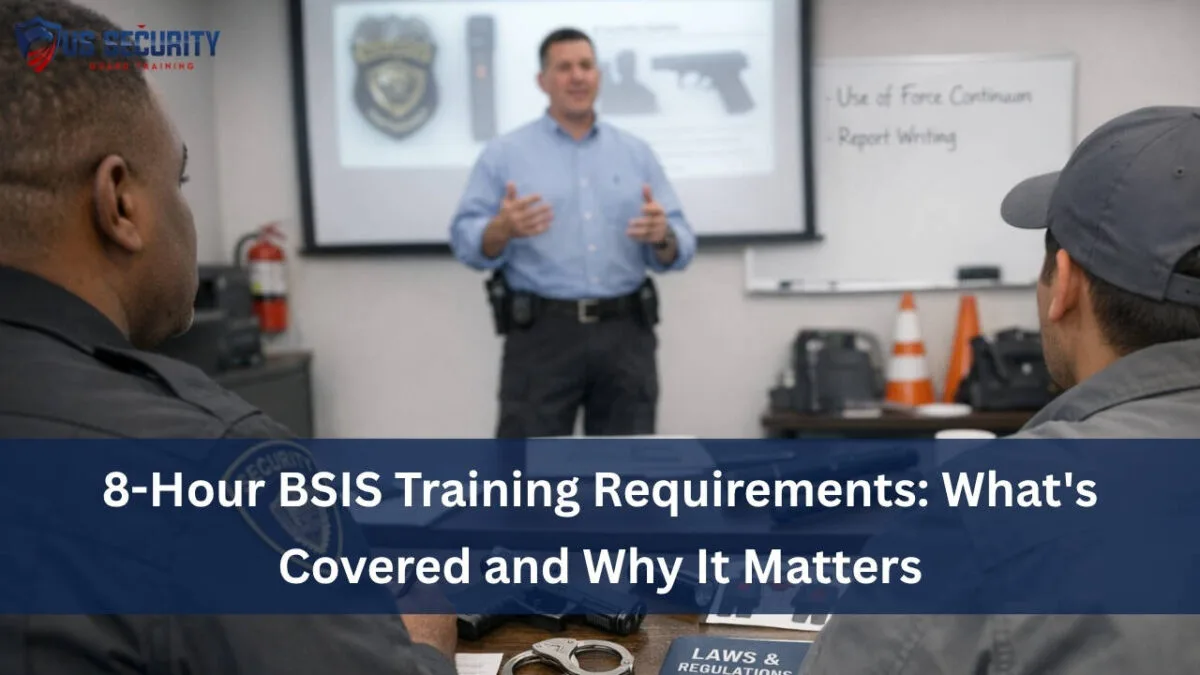


All future security guards in California have to go through the 8-hour BSIS first. This course is not a luxury and BSIS views it as a gateway. This guide subdivides what the course covers, as well as new 2026 rules. You will also get to know about the cost, timing and the next thing. In the end, you will be able to learn the reason why this 8 hour BSIS training is so important.
What Is This Mandatory Training?
The BSIS 8-hour training is the required pre-application training to new guards. It integrates two of the mandated modules on a single certified training provider. An applicant can never register as a guard without completing it. Revision it as the base that each security professional of the future, is steadily building on. Missing links on this can easily bring bigger, more expensive problems in the future.
Who Must Complete This Training
This comprises unarmed guards, patrol officers and most of the private security officers. Even the most skilled guards of other states will have to pass through the course that is specific to California. BSIS does not accept the training certificates of other state agencies.
Why BSIS Requires This Course
Security guards have some limited legal powers, which are not available to ordinary citizens. This safeguards the citizens, the guard and the employer who hired him/her. The untrained guards pose legal risk, safety risk, and reputational risk to all parties.
What This Course Covers
This training is divided into two parts, legally mandated to guards. Each of these modules are not good by themselves, as guards require both of these points of view in combination. Actual cases seldom draw a clear line between law and physical response choices.
The 3-Hour Power to Arrest Module
This module teaches guards the legal limits of a citizen’s arrest. Guards are educated on the time when detention is legal and when it is not. Documentation requirements that should be taken by the instructors after every incident are also discussed.
Legal Authority of Security Guards
The security guards are not police and their authority remains limited. This section explains what guards may and may not do. They teach the students the intersection point of the rights to own property and the rights to preserve safety.
Citizen’s Arrest Rules
Only under the circumstances which are clearly defined, California law permits citizen arrests. Guards should know these rules prior to their action on them. Failure to do so may place guards at a disadvantage of being sued or convicted of crimes.
The 5-Hour Appropriate Use of Force Module.
This extended module trains guards to react safely in confrontations. It focuses on restraint, proportional response, and de-escalation of any physical action. Guards are also taught to be able to record force related incidences in a proper and timely manner.
De-escalation Techniques
Teachers educate about communication skills that lessen the tension before it becomes physical. Such methods safeguard guards, passers-by, and those who are undergoing the attention of guards.
Force Continuum Basics
The force continuum defines the use of the appropriate response to the certain level of threat. Guards are taught to shun underreaction as well as imprudent, excessive overreaction. This systematic methodology ensures consistency, defensibility, and legality of guard decisions.
New 2026 Rules Under SB 652
Recently, Senate Bill 652 amended the training rules in California to a great extent. These developments transform the way that applicants have to undertake their 8 hour BSIS training. The outcome is an identification of a more rigid and uniform process to all new applicants.
The Single-Provider Requirement
By January 1, 2026, one licensed provider will have to provide it all. You cannot divide the sections of Power to Arrest and Use of Force. The providers which refer students to other places are no longer BSIS compliant. This regulation sealed a loophole that has been confusing a large number of new applicants in the past.
The In-Person Training Component
BSIS has now to be provided with a practical component in the 8-hour curriculum model. Only online certification is not enough to meet the full state training need anymore. This alternation makes sure that guards are exercising real scenarios and not passively watching videos. Interactive learning will equip the guards better to handle real-life situations of security that are unpredictable.
The Six-Month Application Window
Within six months of training, applicants have to file their BSIS application. Any training done outside of that window can be ineligible to your application. There is no need to rush to file your Guard Card paperwork until you are sure that your provider has completed his work.
How to Complete Your Required Training
This training is done right and your timeline is safeguarded, and your investment in the application is safeguarded. These are the steps to prevent delays or rejection of applications in future.
Choosing a BSIS-Approved Provider
Enquire particularly about whether they offer both modules with a single certification. Reputable providers who will provide evidence on request will openly assert this.
Passing the Required Exam
The current requirements of BSIS to take this exam are 100 percent and perfect. Prepare well; study your course materials, as repeat may postpone your application even more.
Cost and Timeline of the Training
The providers, location and included study materials, determine the prices of courses. The average fee of most pre-application programs is between fifty and one-fifty dollars. Then you will also pay the independent BSIS application fee. Other providers combine study guides, practice questions or printed workbooks. Comparison of packages, the cheaper packages do not include useful exam preparation materials at times.
What Happens After You Finish
Applying Through BreEZe
The majority of applicants use the system of BreEZe online portal to submit their paperwork in California. Key in your training information as shown on your certificate. Delays incurable here are usually due to mistakes in processing reviews of BSIS.
Live Scan and Next Steps
Registration also requires you to undergo Live Scan fingerprinting. BSIS relies on this background check to verify that applicants are eligible to work across the state. Some beliefs may postpone or cancel an application in this examination.
8-Hour Training vs Other BSIS Requirements
The 8-hour training BSIS is just the tip of the iceberg. Knowledge of future needs aids guards to remain compliant in their whole career.
The 32-Hour Skills Training
On registration, guards are required to undertake another 32 hours of skills training. Sixteen hours are due within your first thirty days working. The rest of the sixteen hours should be completed in six months in total.
Annual 8-Hour Continuing Education
Guards also undertake a separate 8-hour course every year. This is an annual training that updates the use-of-force knowledge and includes regulatory updates as well.
Common Mistakes to Avoid
Minor mistakes at the time of enrollment tend to escalate into weeks of aggravating stalling. These are a few traps to avoid in an effort to keep your application running.
- Selecting a provider that divides training into two companies.
- Allowing your training certificate to run out prior to your BSIS application.
- Presuming that fully online courses meet the existing face-to-face requirement.
Why US Training Guard Recommends Proper Preparation
Informed applicants do not have to waste their money in costly, infuriating delays at US Training Guard. Knowing all the requirements in advance will render your entire licensing process a lot easier. We advise all prospective guards to do their research on providers prior to joining any place.
FAQs
What is this pre-application course?
It integrates Power to Arrest and Appropriate Use of Force teaching.
Do I need this training to get a Guard Card?
Yes, BSIS will not provide a Guard Card without the evidence of completion.
Is this course completely online?
No, existing regulations mandate a physical element with any online education.
What is the average cost of the course?
The most common costs of providers are fifty to one hundred and fifty dollars.
Will I have to take an exam afterwards?
Yes, they have to score 100 percent on the necessary BSIS exam.
What would be the case in case I do not fulfill this requirement at all?
BSIS will reject or send back your Guard Card application.
Conclusion
The first step to licensure is the 8 hour BSIS training. It educates about the law, limits to arrest, and the proper use of force. SB 652 produces new 2026 regulations that enhance the importance of provider choice. Selecting a complaint, one provider insures your time and your investment. Preparation really pays off in the long run of your security career. In the US Training Guard, we make the applicants aware of these requirements.