
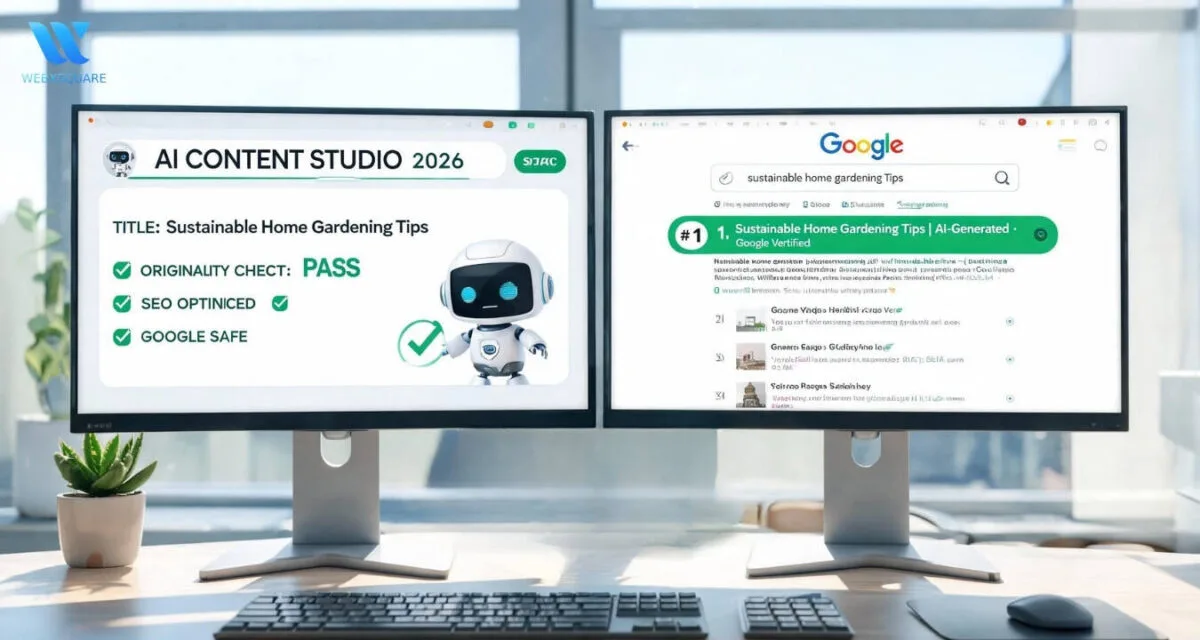


You are not alone, in case you fear that AI content will damage your rankings. The AI generated content SEO and Google rankings have become the trend of this year. Other individuals assert that there is a sure penalty when using AI. Some people claim that it does not affect your traffic at all. The true solution lies in between these two extreme opinions. This becomes a lot easier once you are aware of what Google actually rewards. This guide takes a stroll through what will be different in 2026 and what will continue to matter.
Does Google Actually Care If You Use AI?
No, not, at least not according to the thoughts of the majority. Google has never said that AI writing gets an automatic penalty. It does not matter whether or not your content is helpful to the reader. This is regardless of the writer of an article that is thin and low effort. It did not really matter what tool was used. The most troubling thing about ranking is poor editing and lack of depth. Additionally, AI is used in many sites to accelerate their rough drafts. Then an actual editor will scrutinize all that before it becomes live. The combination of speed and care suits most sites.
It is better to ask, not whether something is AI or human. Is this work in fact responsive to what the reader desires to know? Whether the draft was made or not is much more important than that question. This is the true trial of AI generated content SEO and Google rankings.
AI comes to the rescue of plenty of good content today. It is used by writers as an outline, quick research, or a first draft. After that, it requires real thought and real editing to be done on the finished piece. Readers are not often concerned how a draft was initially begun. They have no interest in whether the end product is useful to them. The systems developed by Google are designed to verify that same simple thing.
What the February 2026 Update Actually Changed
In the start of 2026, Google released a Discover core update. It started on the 5th of February and lasted for almost three weeks. According to Google, the idea was to reduce the number of clickbait headlines. It also sought to increase those sites that demonstrate objective, permanent subject knowledge. A site that had a steady flow of writing on the same subject obviously fared better in this case. In the meantime, websites that run after arbitrary trending topics have not been so successful.
Google did mention that it will bring this update to other locations. Even when you are not in the US it is better to be ready beforehand. Developing positive habits today safeguards you prior to the update coming to you. The larger aspect is that Google is now able to identify expertise on the ground. Such a transition is significant to anyone who is combining AI content with real editing.
How Does Google Spot Low-Quality AI Content?
Google has never made public its exact method of detection. Nevertheless, some helpful hints are provided by preceding updates patterns. It does not seem natural to reviewers to publish dozens of almost-exactly-the-same articles overnight. The repetition of words that appear to be a template is also a red flag. Numbers or claims that have no actual basis are problematic as well.
Technical answers to a question that do not contribute anything new are a failure. Even when the grammar is flawless, that type of thin writing does not work. An enormous amount of unedited AI drafts can damage your reputation quickly. A slower, more cautious pace is much more likely to do much better. Search engines appear to favor those sites where writing is viewed as an art.
Why E-E-A-T Still Matters More Than Ever
E-E-A-T is, you must have heard in SEO circles. It is Experience, Expertise, Authoritative and Trust, all combined. It is this way Google evaluates the quality of content at a more profound level. This is the single thing that AI is unable to imitate: actual experience. It is always evident when a person is reviewing a product he or she has ever used. Such practicality of detail is the result of actual human work.
It does not imply that AI does not fit into your writing process. It implies that AI must accelerate, rather than eliminate human judgment. Allow AI to write the rough structure or do the initial pass. Then get someone who is quite knowledgeable on the subject. They are able to correct errors and provide insightfulness that the AI lacks. Little details can work as well such as providing the name of a real author with credentials. Your trust signal is also created by linking out to reputable, credible sources.
A Simple Way to Publish AI Content Safely
You do not actually require such a complicated system to get this bit right. First, verify all facts that the AI contains with an actual source. Second, bring something helpful that you alone might know or bring. A single clear example, original data or personal experience is quite effective. Thirdly, paraphrase any sentence that can be said about any other web site.
Nothing is as tedious as undress haste. The entire practice is not about using hard and fast rules or checklists. It’s simply a matter of caring about publishing, each time. Consider AI generated content SEO and Google rankings as a single idea.
Common Mistakes That Quietly Hurt Rankings
Most of the ranking harm here is perpetrated by a couple of habits. The largest one is by far the publishing of AI drafts with zero editing. Leaving out fact-checks allows false AI statements to pass unnoticed. When keywords are stuffed all over they render writing sounding like a robot and difficult to read. Imitating a competitor too well also is an indicator of low originality. Overlooking internal links is an easy opportunity to generate authority. There is also weak formatting, where they do not have clear headings, which is also a detriment to reading.
Not all of these errors are, in fact, specific to AI-written text, however. They are nothing more than bad habits that can be repeated more quickly using AI tools. Repairing at least two or three of them is usually an improvement that can be seen in the rankings. The vast majority of such errors occur when AI is seen as a complete product. It is much better as an initial draft, not a complete one. When your team considers each AI draft to be incomplete, quality will increase quickly.
Building a Habit, Not Just a Quick Fix
There is one common denominator of sites that perform well following large updates. They are supported by a consistent approach rather than by ingenious, short-term shortcuts. That implies establishing transparent quality standards prior to any drafting. It involves choosing a person who verifies each piece prior to its publication. It also implies updating the older posts when the facts are out of date.
This consistent practice over time is what appears to have created something that Google systems appear interested in. Reliability gained due to consistent quality surpasses several fortuitous viral posts. This pattern is also detected by the readers, and they begin to trust the site. That is why AI generated content SEO and Google rankings rely heavily upon habit.
FAQs
Does Google punish AI generated content?
No, it is not merely because it was created with the assistance of AI. Google punishes low quality content, unhelpful content or mass-produced content that is of no care. Edited artificial content can be as well ranked as human writing.
What is the appropriate amount of AI content to publish?
Google has never provided an official number or percentage. More important is that each piece has a quality bar that is real.
What’s the best way to fact-check AI content?
Return to primary documents, such as official reports or primary studies. The tool will assist, but a human verification is the most secure option.
Conclusion
AI generated content SEO and Google rankings don’t have to work against each other. They are able to cooperate effectively, provided that real people remain closely engaged. A person has to verify facts, insert actual experience, and safeguard quality. That is what Google is continuing to push towards everyone until 2026. Well, it is the same criteria that has always been used to determine good content. At Webxsquare, this is the exact editorial process we help brands build. The first draft is more quick with AI, yet quality remains in the hands of people.