
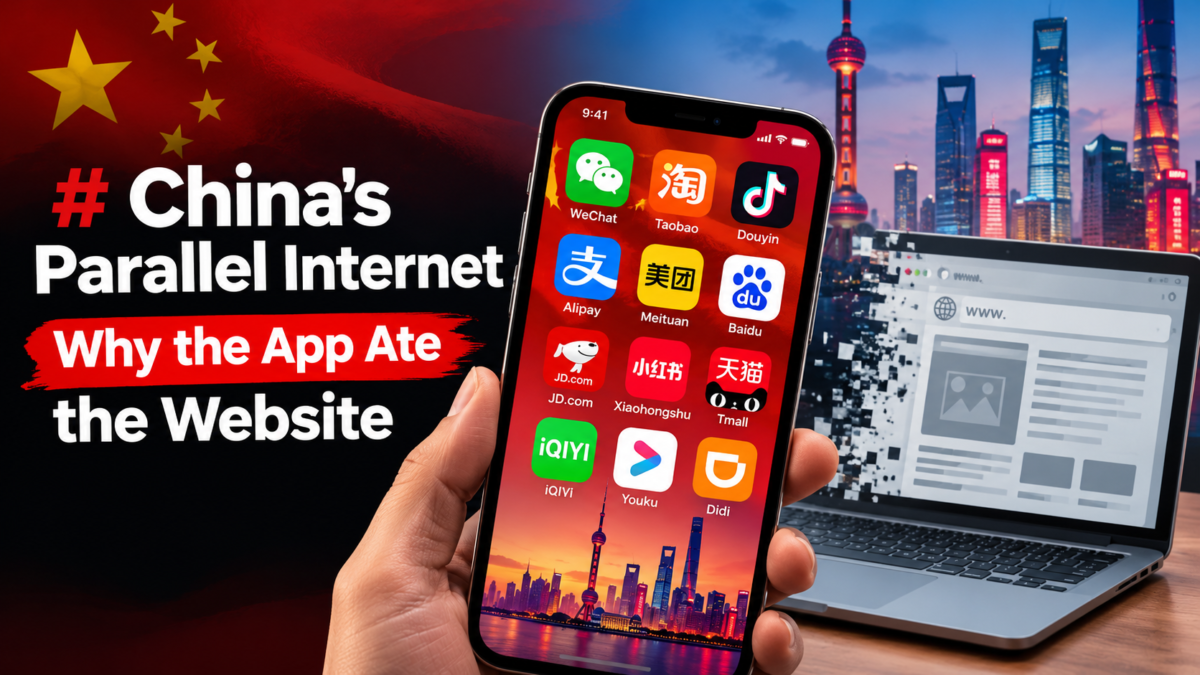


Open an American phone and a Chinese phone side by side and you will see two different internets. The icons barely overlap: where one screen shows WhatsApp, YouTube, and Amazon, the other shows WeChat, Bilibili, and Pinduoduo. The functions rhyme, but the products grew up under separate rules, and understanding those rules is the fastest way to make sense of how more than a billion people actually get online.
The split was not part of the original plan. Early Chinese web companies borrowed openly from Silicon Valley models, and for a time the two ecosystems looked like parallel editions of the same magazine. The divergence came later, driven by regulation on one side and by the speed of mobile adoption on the other. When smartphones put hundreds of millions of first-time users online in a few short years, Chinese companies built for the app first and treated the desktop website as an afterthought. That single decision still shapes everything a newcomer encounters.
Why the app ate the website
The clearest example is WeChat. Western readers often hear it described as China’s WhatsApp, which captures the messaging part but misses most of what the app does. Inside WeChat, businesses run mini-programs that replace entire websites: you book a restaurant, pay the bill, order a taxi home, and file the expense report without ever leaving the chat window. Official Accounts let publishers and brands operate full media channels in the same place. Some small companies have retired their standalone websites altogether because their customers simply never visit them. Anyone who arrives in China expecting to do everything through a browser quickly learns to download the app instead.
Douyin offers a second case study. It shares a parent company and much of its technology with TikTok, yet the two apps run on separate content pools, separate creator economies, and separate e-commerce integrations. A Douyin live stream can move from entertainment to product demonstration to checkout in under a minute, with viewers buying farm produce, cosmetics, and electronics without pausing the video. The format looks familiar to anyone who has watched TikTok Shop, but the conversion rates and the depth of the shopping integration reflect years of iteration on an audience that shops inside video by default.
One question, several answers
Ask what China’s YouTube is and the honest answer is usually more than one product. Bilibili carries the long-form creator culture, complete with its scrolling danmu comments that turn every video into a group chat. iQIYI and Tencent Video hold the licensed drama and film catalogs, functioning closer to Netflix than to YouTube. Short-video platforms take the remainder of viewing time. The same fragmentation applies to e-commerce: Taobao serves the general marketplace role, JD built its reputation on logistics speed and authentic goods, and Pinduoduo won price-sensitive shoppers with group-buying mechanics that have no direct American equivalent. Mapping each Chinese platform to exactly one American counterpart always loses something, which is why a guide pairing Chinese apps with their closest Western analogues works best as a starting point rather than a final verdict.
What survives in the browser
Because the action moved into apps, what remains on the open web is often clunkier than the service it belongs to. Mobile websites render slowly, search results skew toward the platform that owns the search box, and official announcements live inside app feeds that Google never indexes. Practical consequences follow: checking whether a platform is reachable from outside China, finding its real official domain among lookalikes, or confirming who operates it now requires legwork that a simple web search does not provide. Entries for more than twenty categories, from short video and live streaming to fintech, travel, and AI apps, each need the same three facts nailed down: what the platform does, who runs it, and whether an outsider can open it at all.
How to read the landscape without living in it
A few habits keep the learning curve manageable. First, treat every US comparison as a recognition aid, not a claim of equivalence: WeChat resembles WhatsApp the way a Swiss Army knife resembles a pocketknife. Second, expect numbers to move: monthly user figures, app-store availability, and ownership change fast enough that any serious reference dates them or leaves them out. Third, go to the source: every platform page worth trusting links directly to the official site so you can verify the claim yourself. And when something looks wrong, report it through the site’s feedback channel, because reader corrections are how any living reference stays accurate. The parallel internet rewards curiosity, and a little orientation turns confusion into one of the most interesting technology stories of the decade.