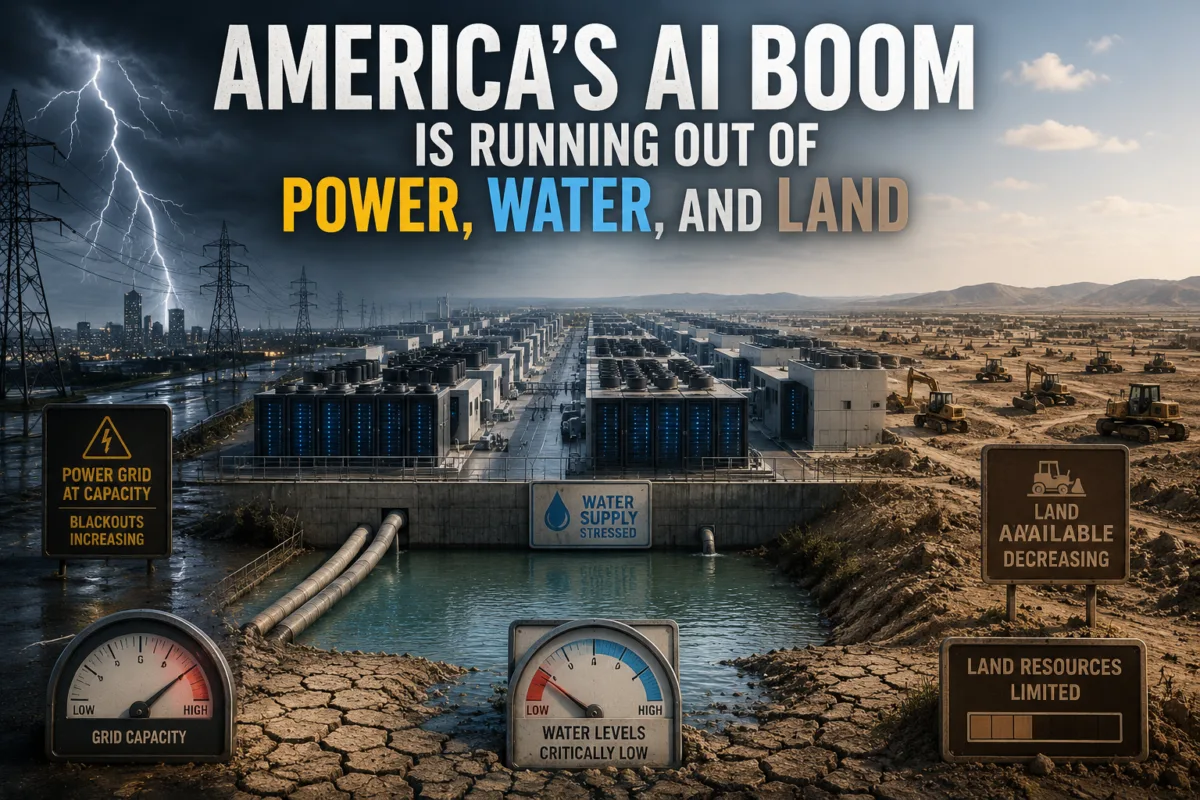


For the past few years, the conversation around artificial intelligence has been almost entirely about software smarter models, faster chatbots, bigger language models. But in June 2026, that conversation shifted dramatically. The real bottleneck for AI is no longer code. It is physical reality.
Power grids are being strained to their limits. Water supplies in some regions are under serious pressure. Land approvals for new data centers are getting blocked by communities and state governments. And the companies spending the most money Google, Microsoft, Meta, Amazon are running into walls that no amount of engineering talent can easily solve.
If you want to understand how technology is reshaping everyday life beyond just AI, check out our earlier breakdown of how digital tools are changing how we find and consume information. But today, the story is bigger and more physical.
The Scale of What Is Being Built Is Hard to Comprehend
To understand why infrastructure has become the defining issue in tech, you have to first understand the sheer size of what is being constructed across the United States right now.
Google, Microsoft, Meta, and Amazon have collectively committed hundreds of billions of dollars to building and expanding data centers across the country. These are not small server rooms. We are talking about massive campuses sometimes the size of multiple city blocks packed with hundreds of thousands of specialized computer chips running around the clock, generating enormous amounts of heat, and consuming electricity at a scale that rivals entire cities.
Numbers That Put It in Perspective
A single large-scale AI data center can consume anywhere from 100 to 500 megawatts of power. For comparison, that is enough electricity to power between 75,000 and 400,000 average American homes. And the industry is planning dozens of these facilities simultaneously across the country.
According to reporting by The Wall Street Journal, a significant portion of planned 2027 data center capacity has not yet broken ground not because the money is not there, but because the land permits, power connections, and environmental approvals are taking far longer than the companies anticipated.
The Power Grid Problem Is Getting Serious
Electricity is the single biggest constraint facing the AI industry right now. Data centers need not just a lot of power, but reliable, uninterrupted power 24 hours a day, 365 days a year. That kind of demand is difficult for aging American power infrastructure to handle at the speed Big Tech is requesting.
States Are Already Pushing Back
Ohio made headlines recently when the state suspended a major tax incentive program for data centers. According to the U.S. Energy Information Administration, states across the country are watching their grid capacity figures carefully as data center demand surges.
Beyond the financial concern, residents in several Ohio communities are now pushing a ballot measure that could actually ban hyperscale data centers from being built in the state at all. This is not an isolated case. Similar pushback is happening in Virginia which already hosts the largest concentration of data centers in the world as well as in Georgia, Texas, and parts of the Pacific Northwest. Communities are raising concerns about noise, water usage, property values, and the strain on local power grids.
The Nuclear Option Literally
Some of the largest tech companies are now making serious moves into nuclear energy as a long-term solution. The appeal is obvious: nuclear power plants produce enormous amounts of electricity with zero carbon emissions and run continuously regardless of weather conditions. Microsoft signed a deal to restart one of the Three Mile Island reactors specifically to power its AI operations. Google and Amazon have also announced nuclear energy agreements in recent months.
This shift tells you something important about how long these companies expect the AI infrastructure build-out to last. Nuclear plants take years to come online. These are decade-scale bets, not quick fixes.
Water Scarcity Has Entered the Conversation
This one caught many people off guard. When SpaceX updated its IPO filing in early June 2026, the company included a warning to investors that access to water is becoming a critical concern for AI infrastructure expansion. That is a remarkable thing to disclose in a tech company filing.
Why Data Centers Use So Much Water
The chips inside AI data centers generate tremendous heat. Cooling that heat requires either large amounts of air conditioning which burns more electricity or water-based cooling systems, which are more efficient but consume vast amounts of water. A large data center can use millions of gallons of water per day.
In drought-prone states like Arizona, Nevada, and parts of Texas, this is a genuine concern. Communities that are already managing limited water resources are now facing requests from tech giants to allocate significant portions of local water supplies to data center cooling systems. Some local governments have started saying no.
Google announced a set of commitments around data center water usage, including a goal to become water-positive by 2030. You can read more about that directly on the Google official blog. Whether that goal is achievable at the pace AI infrastructure is growing remains an open question.
The Money Being Spent Is Staggering Even by Tech Standards
Just to give a sense of the financial scale involved in this infrastructure race right now in June 2026:
Alphabet Google’s parent company announced an $80 billion capital raise, a significant portion of which is earmarked for AI infrastructure. SoftBank committed to investing up to $52 billion in European data centers. France alone attracted over $110 billion in AI investment pledges at a summit hosted by President Macron. Foxconn and Intel announced a partnership specifically focused on AI infrastructure buildout.
What This Means for the Broader Economy
This level of capital spending has real ripple effects throughout the American economy. Construction companies, electrical equipment manufacturers, real estate developers, water management firms, and semiconductor suppliers are all seeing enormous demand driven by the data center buildout. In many states, data center construction has become one of the largest drivers of commercial real estate and infrastructure investment.
For a deeper look at how AI is already changing digital industries closer to home, see our article on the role of AI in elevating digital marketing services the ripple effects reach far beyond just infrastructure.
The AI Infrastructure Race Is Now a Geopolitical Issue
What makes this story more complicated is that it is not just a domestic American issue. China is aggressively building its own AI infrastructure. Europe is racing to establish what policymakers there call technological sovereignty the ability to develop and control its own AI systems rather than depending entirely on American companies.
The US government has responded by restricting the export of advanced AI chips to certain countries, most notably China. This has created a global scramble for access to the most powerful semiconductors primarily produced by Nvidia and has made chip supply a strategic national security issue alongside everything else.
The Infrastructure War Is the AI War
A few years ago, the competition in AI was mostly about which company had the smartest engineers and the best models. Today, the companies and countries that win the AI race will largely be determined by who controls the physical infrastructure. For ongoing coverage of these developments, TechCrunch’s AI section is one of the most reliable places to follow the story.
That is a fundamentally different kind of competition than the software race most people imagined when they first heard about ChatGPT and large language models. It is slower, more expensive, more politically complicated, and arguably more consequential for the long-term balance of global power.
What This Means for Regular Americans
If you are not a tech investor or a data center developer, you might be wondering why any of this matters to you. Here are three direct ways this story touches everyday American life.
First, electricity bills. As data centers consume larger shares of local power grids, utility companies in some regions are already warning of rate increases to fund grid upgrades. In areas with heavy data center concentration, residents may see this reflected in their monthly electric bills in the coming years.
Second, water and environment. Communities near planned data center sites will increasingly find themselves in debates about water allocation, land use, and local environmental impact. This is becoming a local political issue in dozens of states.
Third, jobs and health. The data center construction boom is creating tens of thousands of jobs but it also brings environmental stress. If you are interested in how to protect your own wellbeing in an increasingly tech-saturated world, our article on best foods for brain health is a good place to start.
Frequently Asked Questions (FAQs)
Q1. Why are data centers suddenly such a big deal in 2026?
AI systems require enormous amounts of computing power to train and run. That computing power lives inside data centers. As AI adoption has accelerated across virtually every industry, the demand for data center capacity has grown faster than the physical infrastructure can be built.
Q2. Which states have the most data centers in the US?
Virginia leads by a wide margin and is known as the data center capital of the world. Texas, Georgia, Arizona, and Ohio also have large concentrations of data center infrastructure, though several of these states are now seeing community resistance to further expansion.
Q3. Is the US ahead of China in AI infrastructure?
The US currently leads in overall AI capability and infrastructure, largely due to Nvidia’s dominance in AI chips. However, China is investing heavily in its own chip development and data center buildout. Export restrictions have slowed China’s access to cutting-edge chips, but the gap is narrowing in certain areas.
Q4. Will AI data centers actually affect my electricity bill?
Potentially yes, depending on where you live. In regions with high concentrations of data centers, utilities are investing heavily in grid upgrades, and those costs are sometimes passed on to consumers. This is an active concern in states like Virginia, Texas, and Arizona.
Q5. What is the water-positive goal that Google announced?
Google committed to returning more water to local communities and watersheds than it consumes globally across all operations by 2030. You can read more about these commitments directly on the Google blog. Critics have noted that achieving this goal while simultaneously expanding data center capacity will be extremely challenging.